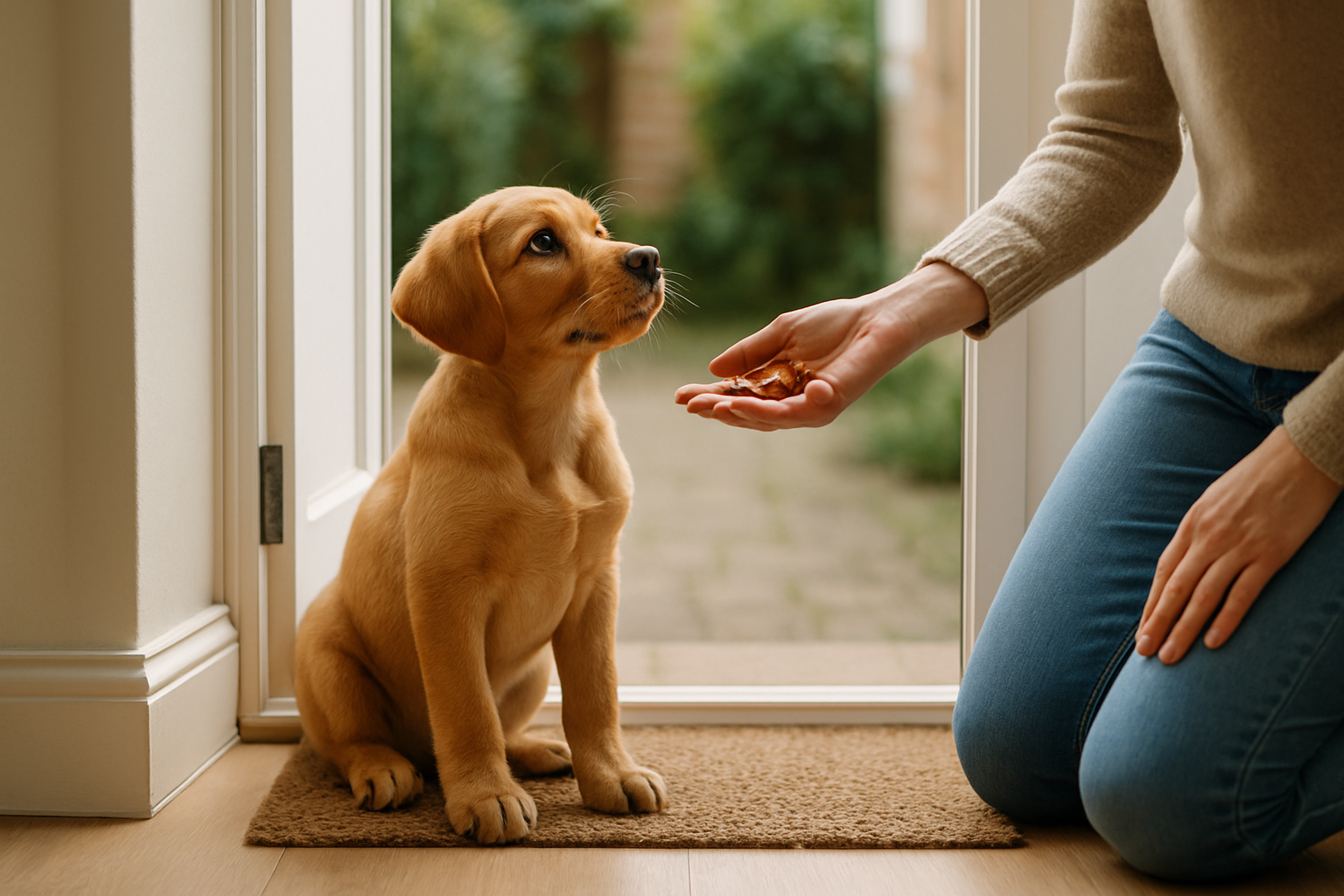
Why Door Training Matters for Your Puppy's Safety
The moment you open a door, your puppy's eyes light up. That threshold represents pure adventure—a portal to new smells, exciting sounds, and endless exploration. Unfortunately, this enthusiasm can quickly turn dangerous. Puppies who haven't learned proper door etiquette may bolt into traffic, get lost in unfamiliar neighborhoods, or collide with family members and guests. [1] Teaching your puppy to wait at doors is one of the most important safety skills you can instill during their early development.
Beyond safety, door training prevents the frustrating habit of dogs pushing past people to exit first. This behavior often stems from the natural canine instinct to investigate new territory, not from dominance issues. [2] When you address door behavior proactively, you're not just solving a training problem—you're preventing potential accidents and building a foundation for lifelong obedience.
Understanding Your Puppy's Door Obsession
Before jumping into training, it helps to understand why puppies are so drawn to open doors. Dogs perceive doorways as gateways to excitement and novelty. Doors also mark the threshold where their owners disappear and return, making them emotionally significant spaces in your puppy's mind. [3] This isn't misbehavior—it's completely normal puppy psychology.
The key to successful training is working with this instinct rather than against it. Instead of physically restraining your puppy or using punishment, you'll teach them that waiting at the door leads to the reward they want: access to the outside world. [2] This approach respects your puppy's nature while establishing the boundaries you need.
What You'll Need to Get Started
The good news? You probably already have everything required for effective door training:
- High-value treats: Choose small, soft treats your puppy absolutely loves—these should be reserved specifically for door training to maintain their motivational power
- A harness and leash: These provide gentle guidance and safety, especially during early training stages
- A clicker or marker word: A clicker device or the word "yes" helps mark the exact moment your puppy performs the desired behavior [5]
- A door: Start with an interior door that doesn't lead to high-excitement areas like the yard
- Patience and consistency: This is your most essential tool—training takes daily practice over several days
Step-by-Step Training for Beginners
Phase 1: Building Awareness (Days 1-2)
Start with the easiest possible scenario. Choose an interior door that leads to a calm, non-threatening space. This removes external excitement and lets your puppy focus on learning.
- Place your puppy on a leash in front of the closed door
- Slowly reach toward the door handle (don't open it yet)
- The moment your puppy looks away from the door or shifts their weight backward, mark the behavior with your clicker or "yes!"
- Immediately deliver a treat, placing it on the floor behind your puppy—away from the door [4]
- Repeat this sequence 5-10 times per session, keeping sessions to just one or two minutes
- Practice three times daily for maximum learning [2]
During this phase, you're teaching your puppy that paying attention to you—not the door—earns rewards. You're not asking for any specific command yet; you're simply rewarding the behavior of disengaging from the door.
Phase 2: Introducing the Opening Door (Days 3-5)
Once your puppy consistently looks away when you reach for the handle, progress to actually opening the door.
- Start with your puppy on a slack leash in front of the door
- Open the door just a crack—barely a few inches [1]
- Wait for your puppy to look away, plant their front feet, or show any behavior incompatible with bolting through
- Mark this behavior immediately and reward with a treat placed behind them
- Close the door and reset
- Gradually increase the door opening by small increments over multiple sessions
The critical principle here is progression through small steps. [2] If your puppy starts to move toward the door, immediately close it and try again with a smaller opening. This isn't punishment—it's simply removing the opportunity to practice the wrong behavior.
Phase 3: Teaching "Sit" at the Door (Days 5-7)
If your puppy already knows "sit," you can accelerate training by incorporating this command.
- Ask your puppy to sit in front of the closed door
- Mark and reward the sit
- Open the door a few inches while your puppy remains sitting
- If they stay seated, mark and reward immediately [3]
- Apply light leash pressure only if your puppy begins to stand—just enough to prevent forward movement, not to force them down
- Gradually widen the door opening over multiple sessions
Remember: the leash should remain slack during successful moments. Think of it as a safety net, not a training tool. [4] Only apply gentle pressure if your puppy attempts to move forward.
Phase 4: Adding Eye Contact and Duration (Week 2)
Once your puppy reliably sits as you open the door fully, add a new element: making eye contact with you.
- Open the door completely with your puppy sitting
- Wait for your puppy to look at your face
- Mark and reward this eye contact [5]
- Gradually increase the duration they hold eye contact before receiving a reward
- Practice with the door open for 5-10 seconds before rewarding
This phase teaches your puppy that looking to you for permission is the pathway to going through the door. You're establishing you as the decision-maker at thresholds.
Introducing a Release Cue
After your puppy has mastered waiting with an open door, introduce a release word that signals permission to exit. Common choices include "okay," "free," or "let's go." [4]
- With your puppy sitting at the open door, say your release word in a happy, encouraging tone
- Immediately step aside or gesture forward to invite movement
- Reward your puppy as they move through the threshold
- Practice this sequence until your puppy anticipates the release and moves forward promptly
The release cue becomes incredibly valuable because it gives you control over when your puppy can exit. On busy mornings when you're in a hurry, you can simply say the release word without practicing the full wait sequence. [5]
Proofing Your Training: Making It Real-World Ready
Teaching your puppy to wait at an interior door is just the foundation. Real-world success requires "proofing"—practicing the behavior in varied situations with different distractions. [1]
Progressive Difficulty Levels:
- Different doors: Practice at your front door, back door, garage door, and car door
- Various locations: Train at friends' homes, training facilities, and different environments
- Different handlers: Have family members practice the same routine so your puppy responds to everyone
- Added distractions: Introduce toys, make sounds, or have someone ring the doorbell while practicing [1]
- Higher-value scenarios: Eventually practice with exciting situations on the other side, like another dog or person visible through the window
The Distraction Progression Strategy:
When adding a new distraction or practicing at a new location, temporarily make the door-opening phase easier. [1] For example, if you're practicing at your front door for the first time, only open it a crack instead of fully. Once your puppy succeeds at this reduced difficulty with the new distraction, gradually increase the door opening again.
Introduce only one new challenge at a time. Adding multiple new elements simultaneously overwhelms your puppy and undermines training progress.
Special Considerations for High-Drive Puppies
Some puppies—particularly those from working or sporting breeds—have naturally high drives and may find door training more challenging. [3] For these enthusiastic learners:
- Use clear body language: Maintain steady, almost robotic movements to provide crystal-clear communication about what you expect
- Increase practice frequency: High-drive puppies benefit from more frequent, shorter training sessions—perhaps five one-minute sessions daily instead of three
- Use higher-value rewards: These puppies may need more compelling rewards than standard treats; consider access to play or the door itself as a reward
- Build impulse control elsewhere: Supplement door training with other impulse control exercises like "leave it" and "wait" during meals
Troubleshooting Common Problems
My puppy keeps trying to bolt through
This means you've progressed too quickly. Go back to a smaller door opening or an earlier training phase. [2] Success builds confidence and understanding—never skip steps to rush progress. If your puppy fails twice at the same level, reduce difficulty and use higher-value treats.
My puppy ignores treats when excited about the door
Motivation is relative to the situation. [4] If your puppy values access through the door more than any treat you're offering, use that door access as the primary reward. Say your release cue, let them through, and celebrate their success. You can still use treats during lower-excitement training sessions.
My puppy does great in training but ignores the command with visitors
This is completely normal and doesn't mean training failed. [2] Excitement from guests creates a different training scenario. Practice door waiting with visitors present, starting at an easier difficulty level. Have guests knock softly at first, gradually increasing the realism of the scenario.
My family members aren't consistent
Inconsistency is a primary reason door training stalls. [2] Have a family meeting and ensure everyone practices the same routine. Post a simple written guide near the door as a reminder. Consistency across all handlers dramatically accelerates learning.
Training Timeline: What to Expect
Most puppies show noticeable improvement within 3-5 days of consistent practice. However, true reliability—where your puppy waits at doors automatically in all situations—typically takes 2-4 weeks of daily training. [2] Remember that puppies haven't developed full impulse control yet, so patience is essential.
The timeline varies based on your puppy's age, breed, temperament, and how consistently you practice. A 16-week-old puppy will progress faster than an 8-week-old. High-energy breeds may take longer than naturally calm breeds. This is perfectly normal.
Extending Training to Gates and Other Thresholds
Once your puppy masters doors, the same principles apply to gates, car doors, crate doors, and even curbs. [4] The training is identical—you're teaching your puppy to pause at any threshold and check in with you before proceeding. This generalization of the behavior makes it incredibly valuable for lifetime safety.
Key Takeaways for Success
- Start with interior doors in low-excitement environments to build foundational understanding
- Progress through small, incremental steps—never rush to the next difficulty level
- Use high-value treats and a clicker or marker word for precision marking
- Practice three short sessions daily for maximum learning retention
- Ensure all family members follow the same training protocol consistently
- Proof the behavior in different locations, with different people, and with increasing distractions
- Use a release cue to give yourself control over when your puppy exits
- Celebrate small successes—this is a relationship-building experience, not a power struggle
Teaching your puppy to wait at doors is one of the most practical, safety-critical skills you can instill. It requires patience and consistency, but the payoff is immeasurable: a puppy who won't bolt into traffic, who won't escape from your home, and who respects thresholds throughout their lifetime. Start today, practice consistently, and watch your puppy develop the self-control that will keep them safe for years to come.
Sources & References
- https://bestfriends.org/pet-care-resources/how-teach-dog-wait-door
- https://www.doggoneproblems.com/bella-bane-killer-teach-dogs-to-wait-at-the-door/
- https://www.thepuppyacademy.com/blog/2021/8/9/puppyhood-made-easy-for-new-owners-teach-your-puppy-not-to-bolt-out-of-doorways
- https://kikiyablondogtraining.com/kiki-blog/2018/1/7/teach-your-dog-to-wait-at-doors
- https://petexpertise.com/blogs/all/how-to-train-a-dog-to-wait-before-going-out-the-door