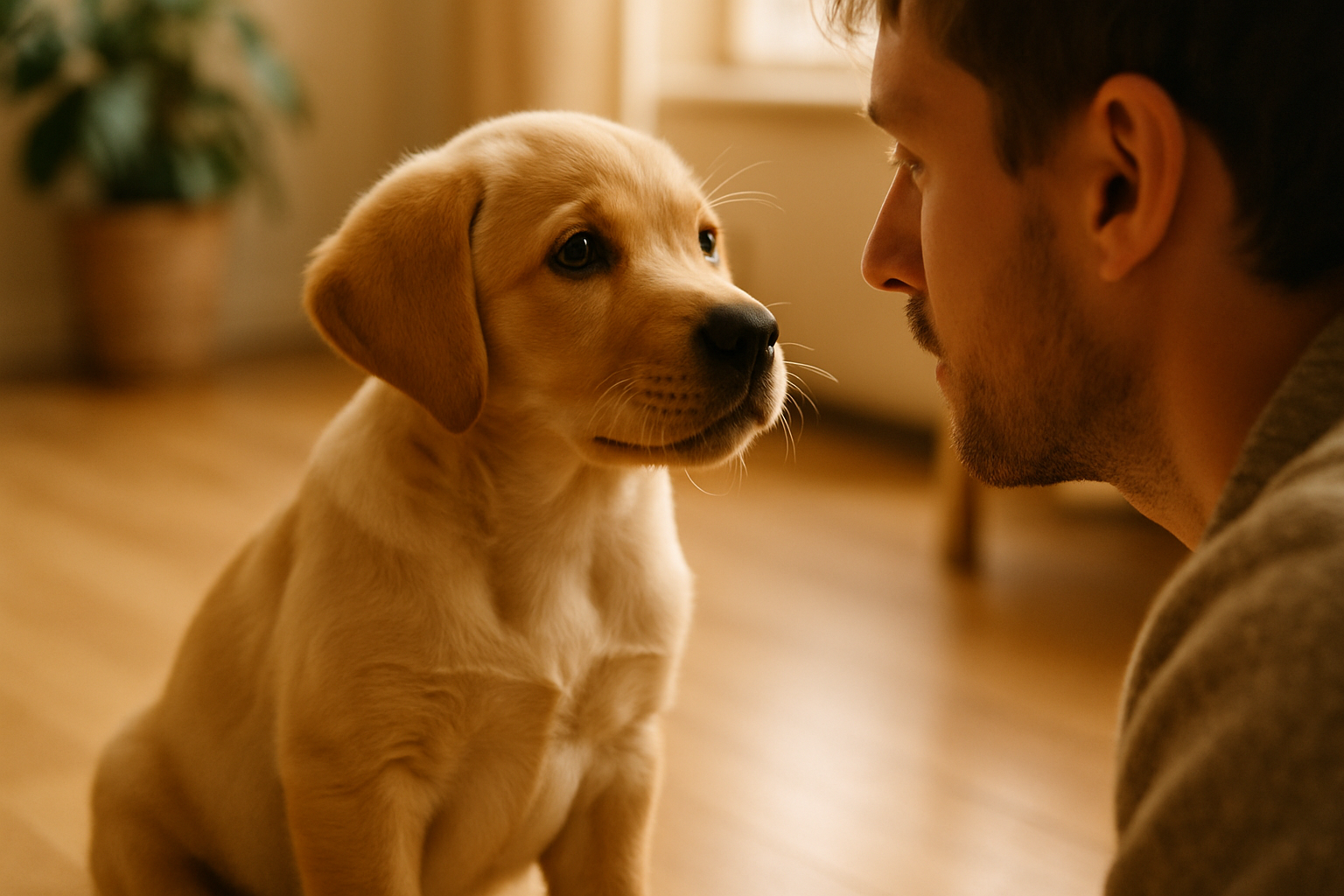
Why Teaching Your Puppy to Look at You Matters
If you've ever struggled to get your puppy's attention in a distracting environment, you understand the challenge. A puppy who can lock eyes with you on command has developed something far more valuable than just a cute party trick. This foundational skill creates the gateway to all other training success.
When your puppy makes eye contact with you, they're demonstrating focus, trust, and engagement. This connection is essential for safety—imagine your puppy about to chase a squirrel into traffic, and you call out "Look at me!" A well-trained puppy will redirect their attention to you instead, potentially saving their life. [1] Beyond safety, eye contact training strengthens the emotional bond between you and your furry companion, making them more responsive to future commands and more attuned to your needs.
From a neurological perspective, when your puppy makes eye contact with you, their brain releases oxytocin—the same bonding hormone that strengthens human relationships. This means every successful eye contact moment is literally building your relationship at a chemical level.
Understanding Your Puppy's Natural Attention Span
Before diving into training, it's crucial to understand that puppies are not small dogs with small brains—they're developing creatures with genuinely limited attention spans. Research shows that puppies can focus for approximately 3-5 minutes during training sessions, especially when they're young. [1] This isn't a limitation; it's simply their developmental stage.
Puppies between 8-16 weeks are in their prime learning window, absorbing information like tiny sponges. [5] However, their ability to concentrate is heavily influenced by their environment, energy level, and what's happening around them. A puppy in a quiet living room can focus differently than one in a park surrounded by fascinating smells and other dogs.
The key is working with this natural limitation rather than against it. Short, frequent training sessions will yield better results than one long marathon session that leaves your puppy frustrated and you exhausted.
Preparing for Success: The Foundation Before Training
Successful eye contact training doesn't begin with commands—it begins with preparation. Creating the right environment and gathering the right tools sets you up for victories from day one.
Choose Your Training Space Wisely
Start training in a quiet, low-distraction environment. Your living room is ideal for initial sessions; the backyard comes later. Minimize visual distractions, turn off the television, and ask family members to give you space. Once your puppy reliably makes eye contact in calm settings, gradually introduce more challenging environments. [5]
Select High-Value Rewards
Not all treats are created equal in your puppy's mind. High-value rewards are foods your puppy genuinely loves—perhaps small pieces of chicken, cheese, or specialized training treats. [5] The reward must be more interesting than whatever else is competing for their attention. During initial training, save these premium rewards exclusively for eye contact practice. Once the behavior is established, you can gradually introduce variable rewards (sometimes a treat, sometimes praise, sometimes a toy).
Some puppies are more motivated by play or affection than food. Observe your individual puppy's preferences. [1] A toy-motivated puppy might work harder for a brief play session than for a treat.
Gather Your Training Tools
You'll need:
- High-value treats cut into small, pea-sized pieces
- A clicker (optional but highly effective)
- A quiet space free from distractions
- Patience and a positive mindset
The clicker is a small device that makes a distinctive sound, marking the exact moment your puppy performs the desired behavior. It bridges the gap between the behavior and the reward, helping your puppy understand precisely what earned them the treat. [2]
Step-by-Step Training Protocol
Phase 1: Capturing Natural Eye Contact (Week 1-2)
Before teaching your puppy to look at you on command, you'll reward them for making eye contact naturally. This builds their understanding that looking at your face results in good things.
The Process:
- Sit or kneel at your puppy's level in your quiet training space
- Hold a treat near your face, slightly above eye level
- Wait quietly. Don't say anything—just be present
- The moment your puppy's eyes meet yours, click your clicker (if using one) or say "Yes!" enthusiastically
- Immediately deliver the treat to their mouth
- Repeat 5-10 times per session, keeping sessions to 3-5 minutes
- Practice 2-3 times daily
During this phase, your puppy learns the equation: eye contact with human = reward appears. You're not using a command yet—you're simply rewarding the behavior whenever it happens naturally.
Phase 2: Adding the Verbal Cue (Week 2-3)
Once your puppy consistently makes eye contact when you're holding a treat near your face, you're ready to add a verbal cue. Choose a short, distinctive word. Popular options include "Look at me," "Watch me," or simply "Eyes."
The Process:
- Position yourself as before with a treat near your face
- Say your chosen cue word clearly and enthusiastically: "Look at me!"
- Wait for eye contact
- Click and reward immediately when it happens
- Practice 5-10 repetitions per session
- Gradually, your puppy will begin making the connection between the word and the action
Consistency is paramount here. Everyone in your household must use the identical cue word and delivery method. [4] If one person says "Look at me" while another says "Eyes," you're confusing your puppy and slowing progress.
Phase 3: Fading the Lure (Week 3-4)
Now comes the critical transition from luring to commanding. Your puppy has learned that "Look at me" predicts a reward, but they're still dependent on seeing the treat near your face.
The Process:
- Say your cue word: "Look at me!"
- Hold your hand (without a visible treat) near your face
- When your puppy looks at you, click and deliver a reward from your other hand or pocket
- Gradually move your hand further from your face over multiple sessions
- Eventually, your puppy will make eye contact with just your face, not your hand
This phase requires patience. You're essentially teaching your puppy that the reward is still coming, even though they can't see it in your hand. Some puppies catch on immediately; others need several days of practice. [1]
Phase 4: Building Duration and Distance (Week 4+)
Your puppy can now make eye contact on command in your quiet training space. Time to build reliability and extend the behavior's usefulness.
Increasing Duration:
- After your puppy makes eye contact, wait 1-2 seconds before clicking and rewarding
- Gradually extend this duration to 5-10 seconds
- Never rush this process—if your puppy breaks eye contact, simply start over
Increasing Distance:
- Practice the command from slightly further away (3 feet, then 5 feet, then across the room)
- Always ensure success by not increasing distance too quickly
- Return to closer distances if your puppy struggles
Changing Environments:
- Once reliable at home, practice in your backyard
- Then try less distracting outdoor locations like quiet parks
- Gradually introduce more challenging environments
- Always use higher-value rewards in new or distracting settings
Positive Reinforcement: The Science Behind Why It Works
Throughout this training process, positive reinforcement is your primary tool. According to the American Veterinary Society of Animal Behavior, rewards-based training offers the most advantages with the least potential harm to your puppy. [1] This isn't just humane—it's scientifically proven to be more effective.
When your puppy associates eye contact with positive outcomes, they become eager to repeat the behavior. They're not complying out of fear; they're choosing to engage with you because it's rewarding. [3] This creates a fundamentally different relationship than training methods based on correction or punishment.
Positive reinforcement also strengthens the bond between you and your puppy. Every training session becomes an opportunity to communicate "I see you, I appreciate you, and I'm rewarding your good choices." [1]
Common Challenges and Solutions
Challenge: Your Puppy Won't Make Eye Contact
If your puppy consistently avoids looking at your face, several factors might be at play:
- The environment is too distracting: Return to your quietest space and remove all competing stimuli
- Your puppy isn't motivated by your chosen reward: Experiment with different treats or toys to find what truly excites them
- Your puppy is too tired or overstimulated: Train when your puppy is alert but calm, typically after a nap or light play session
- Your puppy has learned that looking away gets attention: Ensure you're only rewarding eye contact, never rewarding avoidance with interaction
Challenge: Your Puppy Makes Eye Contact Inconsistently
Inconsistent responses are normal during learning. [4] This doesn't mean your puppy is stubborn—it means they haven't fully generalized the behavior yet. Return to shorter training sessions with higher-value rewards. Practice more frequently but for briefer periods.
Challenge: Your Puppy Breaks Eye Contact Quickly
Puppies have genuine attention limitations. If your puppy consistently breaks eye contact within 1-2 seconds, you're asking for too much duration too quickly. Reward them for whatever length of eye contact they're currently capable of, then gradually extend it.
Challenge: Your Puppy Only Responds When They See a Treat
This means you're still in the luring phase. Be patient and continue practicing Phase 3 (fading the lure) for several more days or weeks. Some puppies need extended practice before they understand that the reward is coming even without a visible cue.
Training Timeline and Realistic Expectations
How quickly will your puppy master eye contact? It depends on several factors: their age, breed predisposition, individual temperament, and training consistency. [2] Most puppies can learn basic eye contact within 2-4 weeks of consistent practice. However, reliability in distracting environments may take several months of ongoing practice.
Remember that puppies, like humans, have good days and bad days. A puppy who performs perfectly during morning training might be distracted and unmotivated by evening. This is normal development, not regression.
Integrating Eye Contact Into Daily Life
Once your puppy has learned to make eye contact on command, integrate this skill into everyday interactions:
- Before meals: Request eye contact, then place their food bowl down
- Before walks: Ask for eye contact before clipping on the leash
- Before playtime: Make it a prerequisite for throwing the ball
- During distracting moments: Use the command to redirect attention from squirrels, other dogs, or interesting smells
This integration makes eye contact a practical tool rather than just a training exercise. Your puppy learns that looking at you unlocks all the good things in their world.
When to Seek Professional Help
If after 4-6 weeks of consistent practice your puppy still isn't responding to eye contact training, consider consulting a certified professional dog trainer. [2] They can assess whether underlying issues—such as fear, anxiety, or sensory sensitivities—are interfering with learning. A professional can also tailor training to your specific puppy's learning style and needs.
Key Takeaways for Success
- Start training in quiet, low-distraction environments and gradually increase difficulty
- Use high-value rewards that genuinely motivate your individual puppy
- Keep training sessions short (3-5 minutes) and frequent (2-3 times daily)
- Always use positive reinforcement—reward the behavior you want to see more of
- Be consistent with your cue word and training method across all family members
- Gradually fade the lure, increase duration, and change environments
- Expect variability in performance as your puppy learns
- Integrate eye contact into daily life to build reliability
- Celebrate small victories—training is a journey, not a destination
Teaching your puppy to look at you on command is more than training—it's building a foundation of communication and trust that will serve you both for years to come. [3] Every moment of eye contact is a moment of connection, a reminder that your puppy sees you and chooses to engage with you. That's the real reward.
Sources & References
- https://embarkvet.com/resources/how-to-train-a-new-puppy-commands-rewards-building-a-routine/
- https://ninawoof.com/blogs/blog/master-basic-dog-commands-like-a-pro-a-step-by-step-guide-to-unlocking-your-pups-potential
- https://www.marketplaceveterinary.com/blog/its-a-good-thing-youre-cute-our-dog-training-guide/
- https://faithfulfriendsvetclinic.com/training-a-new-puppy/
- https://www.caldwellanimalhospital.org/2025/01/15/essential-training-tips-for-raising-a-happy-and-healthy-puppy-or-kitten/