Why Target Training Deserves a Spot in Your Training Toolkit
Most dog owners are familiar with the basics: sit, stay, come. But there's a hidden gem in the world of dog training that remains mysteriously underutilized outside professional circles—targeting. Despite its remarkable versatility and simplicity, many dog owners have never heard of it, let alone considered teaching it to their canine companions.
Targeting is the foundation for building focus, strengthening your recall command, and creating a more responsive dog overall. Whether you're managing a reactive pup in crowded spaces, boosting your timid dog's confidence, or simply looking for a mental enrichment activity, targeting offers solutions that few other training methods can match. [1]
Understanding What Targeting Actually Is
At its core, targeting means teaching your dog to deliberately touch a designated object or location with a specific body part—most commonly their nose, but also their paws, shoulder, hip, or even their ear or tail. [1] The target itself can be virtually anything: your open palm, a closed fist, a finger, a commercial target stick, a spot on your wall, a household object, or any item you choose.
The beauty of targeting lies in its simplicity and the clarity it provides to your dog. Rather than relying on lures or physical guidance, you're teaching your dog to actively participate in the learning process by offering a specific behavior. This creates what trainers call an "offered behavior"—your dog figures out what works and offers it willingly. [2]
The Real-World Benefits of Targeting
Beyond the novelty factor, targeting serves genuinely practical purposes in everyday life:
- Improved Focus and Attention: Targeting redirects your dog's attention away from distractions and toward you, making it invaluable in crowded parks or busy streets. [2]
- Enhanced Recall: When your dog is far away or distracted, the touch command can bring them running directly to you, providing a safety tool when you need it most. [2]
- Confidence Building: Especially for timid or anxious dogs, successfully completing targeting exercises creates positive associations with challenging situations and unfamiliar objects. [1]
- Reactive Dog Management: Dogs struggling with reactivity or anxiety can refocus on you rather than their triggers. [3]
- Navigation Through Stressful Situations: Whether at the vet's office or in a crowded environment, a solid target command gives your dog a job to focus on rather than their anxiety. [3]
- Foundation for Advanced Skills: Targeting serves as the building block for sports training, agility work, and complex tricks. [1]
- Mental Stimulation: Targeting keeps your dog's mind sharp and engaged, making it perfect for senior dogs or those with limited mobility. [1]
Getting Started: Hand Targeting Step-by-Step
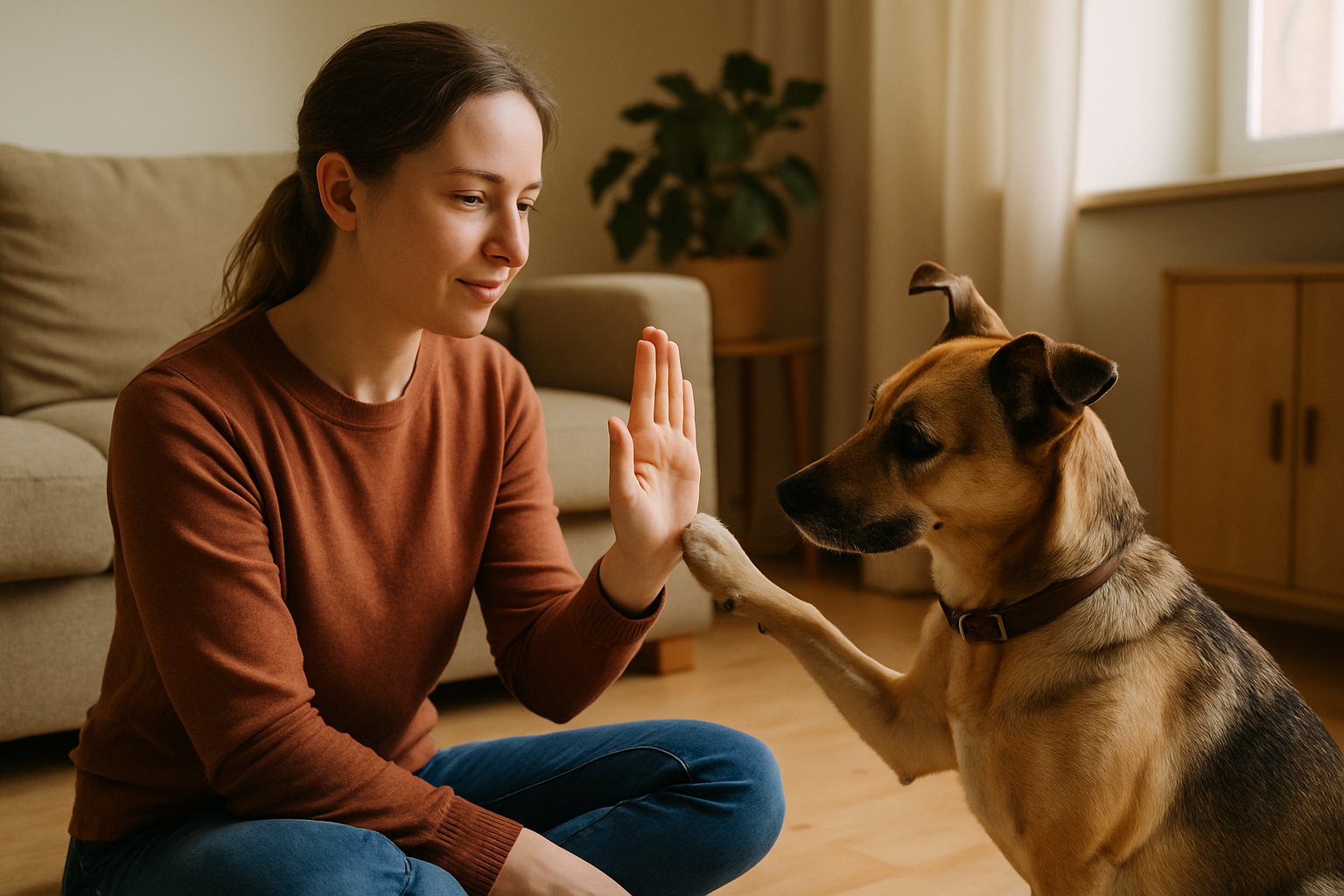
The most accessible entry point to targeting is hand targeting—teaching your dog to touch your open palm with their nose. This requires no special equipment beyond what you likely already have: your hand, treats, and optionally a clicker. [1]
Step 1: Set Up for Success
Begin in a quiet, distraction-free environment where your dog can focus entirely on you. Have your dog sit in front of you at a comfortable distance. This isn't about formal obedience; you simply want their attention available. [2]
Step 2: Present Your Hand as a Target
Hold your open hand at your dog's nose level with your palm facing them and fingers pointing downward. This positioning naturally invites investigation. If your dog shows no interest, rub a high-value treat (hot dog, cream cheese, or moist training treat) onto your palm to make it more enticing. [1]
Step 3: Capture That First Touch
The moment your dog's nose makes contact with your skin—not just comes close, but actually touches—mark the behavior immediately with either a clicker or a verbal marker like "Yes!" Then immediately deliver a treat. The timing of your marker is crucial: too early, and your dog learns to stop short; too late, and they learn that moving away earns the reward. [1]
Step 4: Repeat and Refine
Remove your target hand and offer it again in the same position. Your dog will likely sniff again due to what trainers call "novelty of stimulus"—the natural curiosity dogs have toward new things. Catch this sniff with your marker and treat. Repeat this cycle multiple times in a single session. [1]
Step 5: Navigate the Motivation Shift
After several repetitions, your dog may stop investigating your target hand and instead stare directly at your treat hand. This is actually progress—your dog is thinking, but they've figured out the shortcut to rewards. When this happens, hide your treat hand behind your back and offer only your target hand. Wait patiently. Your dog will eventually investigate the target hand again. If they don't, step backward a few steps and present the target hand as they move toward you. When they touch, mark and reward enthusiastically. [1]
Step 6: The "Aha" Moment
This is where the magic happens. Your dog will eventually demonstrate deliberate, purposeful nose touches to your hand—no luring, no food on your palm, just a clear decision to touch. This is the moment when your dog truly understands the game. Some dogs achieve this in three repetitions; others need more time. Variables like your timing, your dog's treat motivation, and environmental distractions all influence learning speed. [1]
Step 7: Add Your Verbal Cue
Once your dog is consistently and deliberately touching your hand, introduce a verbal cue such as "Touch" or "Target." Say the cue just before presenting your hand, then mark and reward when they comply. After several repetitions with the cue, your dog will begin associating the word with the behavior. [2]
Step 8: Increase Difficulty Gradually
Start presenting your hand in different positions—higher, lower, to the side, further away. This teaches your dog that targeting works regardless of where your hand appears. Progress to working in environments with mild distractions, then gradually increase the challenge. [3]
Extending Your Reach: Target Stick Training
Once your dog masters hand targeting, you can extend your reach with a target stick. This simple tool—which can be commercially purchased or homemade from a dowel rod with a ball attached—allows you to cue targeting from greater distances. [1]
The training process mirrors hand targeting: present the stick, mark when your dog's nose touches it, and reward. Because your dog already understands the concept of nose targeting, they typically learn stick targeting very quickly. This opens up new possibilities for working with your dog in larger spaces or when you need to maintain greater distance.
Beyond the Nose: Paw Targeting
Once you've mastered nose targeting, you can explore paw targeting—teaching your dog to place their front paws on an object. This variation builds core strength, improves balance, and serves as a foundation for agility and trick training. [3]
How to Teach Paw Targeting
Start with a low, stable platform such as a book, solid box, or training platform. Begin by marking and rewarding your dog simply for looking at the platform, then for sniffing or engaging with it in any way. This desensitization step ensures your dog is comfortable with the object. [3]
Next, use a treat to lure your dog's nose upward and over the platform. As their nose follows the treat, their front feet will naturally rise onto the object. The moment their paws contact the platform, mark the behavior and deliver a reward while their paws are still elevated. [3]
Repeat this process until your dog consistently places their paws on the platform as you lure. Then introduce your verbal cue—"Paws up" or "Paws"—as they make contact. After several repetitions, fade the lure and rely solely on your cue. [3]
For dogs that are nervous about the platform, start by rewarding them for simply approaching it or placing just one paw on it. Build confidence gradually rather than forcing the behavior. [3]
Practical Applications in Daily Life
Understanding the mechanics of targeting is one thing; knowing how to apply it transforms your dog's behavior. Consider these real-world scenarios:
Managing Reactivity During Walks
When your dog begins fixating on another dog, person, or trigger, the touch command redirects their focus to you. Rather than allowing them to rehearse reactive behavior, you've given them an alternative response that earns rewards. Over time, this rewires their emotional response to triggers. [2]
Navigating Crowded Spaces
In parks or busy areas, instead of allowing your dog to greet every person they encounter, you can use the touch command to keep them close and focused. This prevents jumping, keeps them safe from potential hazards, and maintains your control of the situation. [2]
Overcoming Fear of Objects
If your dog is anxious about vacuums, umbrellas, or other household items, you can systematically teach them to touch these objects in a controlled, rewarded way. This gradual exposure combined with positive association can significantly reduce fear responses over time. [2]
Vet Visit Preparation
Teaching your dog to hold their nose steady on your hand during targeting practice is excellent preparation for vet exams. Your dog learns to remain still and focused, making examinations less stressful for everyone involved. [2]
Troubleshooting Common Challenges
Not every dog learns targeting at the same pace, and obstacles are normal. Here's how to address common issues:
Your Dog Shows No Interest in Your Hand
This usually indicates insufficient motivation. Increase treat value dramatically—use something your dog finds irresistible. Alternatively, rub a treat directly on your palm to make it more aromatic and appealing. [1]
Your Dog Keeps Staring at Your Treat Hand
This is actually a sign your dog is learning to problem-solve, just in the wrong direction. Hide your treat hand completely behind your back, then present only your target hand. Wait patiently. Your dog will eventually investigate the available option. [1]
Your Dog Struggles with Paw Targeting
Lower your expectations initially. Reward your dog for approaching the platform, then for sniffing it, then for placing one paw on it. Build in small increments rather than expecting immediate mastery. [3]
Training Sessions Aren't Productive
Keep sessions short—5 to 10 minutes maximum—and practice with intervals for your dog to rest. Multiple short sessions spread throughout the day often produce better results than one long session. Also ensure your dog is adequately motivated; they should succeed and receive rewards in the majority of their attempts. [2]
Your Dog Learns Hand Targeting But Won't Generalize
Gradually introduce variations: different hand positions, different distances, different environments. Build distractions slowly rather than jumping from a quiet room to a busy park. [3]
Advanced Applications and Tricks
Once your dog has mastered basic targeting, the possibilities expand significantly. You can teach your dog to turn lights on and off, close doors, ring doorbells, or navigate agility contact zones. [1] You can even develop targeting into entertaining parlor tricks or prepare your dog for canine sports like freestyle dancing and rally obedience. [1]
The key is recognizing that targeting isn't an endpoint—it's a foundation upon which you can build countless behaviors and tricks. Each new application reinforces your dog's understanding that touching designated objects on command earns rewards.
Special Considerations for Different Dogs
Targeting works for virtually every dog, but some populations benefit especially from this training:
Senior Dogs and Dogs with Limited Mobility: Targeting requires minimal physical exertion, making it perfect for older dogs or those recovering from injury or illness. It provides mental stimulation without taxing their bodies. [1]
Timid or Anxious Dogs: Successfully completing targeting exercises builds confidence gradually. The clear, achievable nature of the task helps nervous dogs develop trust in their training and in you. [1]
High-Energy Dogs: Targeting channels mental energy productively, providing intellectual engagement that can tire a dog as effectively as physical exercise. [1]
Dogs in Recovery: During rehabilitation from illness or injury, targeting offers enrichment when other activities aren't appropriate. [5]
Making Targeting Part of Your Training Routine
To maximize the benefits of targeting, integrate it into your regular training schedule:
- Practice targeting daily, even if just for 5-10 minutes
- Use targeting as a warm-up before other training sessions
- Incorporate targeting into real-world situations once your dog demonstrates reliability
- Rotate between hand targeting, stick targeting, and object targeting to maintain novelty
- Use targeting as a foundation for teaching new tricks and advanced behaviors
- Celebrate small wins—every successful touch is progress
The Lasting Impact of Target Training
What begins as a simple game—touching your hand for a treat—evolves into a powerful communication tool between you and your dog. Targeting teaches your dog that paying attention to you is rewarding, that engaging with your cues produces positive outcomes, and that they have agency in the training process.
Beyond the practical applications, targeting strengthens your relationship. It demonstrates to your dog that you notice and reward their efforts, that learning is fun and safe, and that working together produces mutual satisfaction. These lessons generalize far beyond targeting itself, influencing how your dog approaches all training and all interactions with you.
Whether you're addressing behavioral challenges, preparing for sports training, enriching your senior dog's life, or simply looking for a fun new skill to teach, targeting offers remarkable value with minimal equipment and effort. It's time this underrated, versatile behavior received the attention it deserves in mainstream dog training.