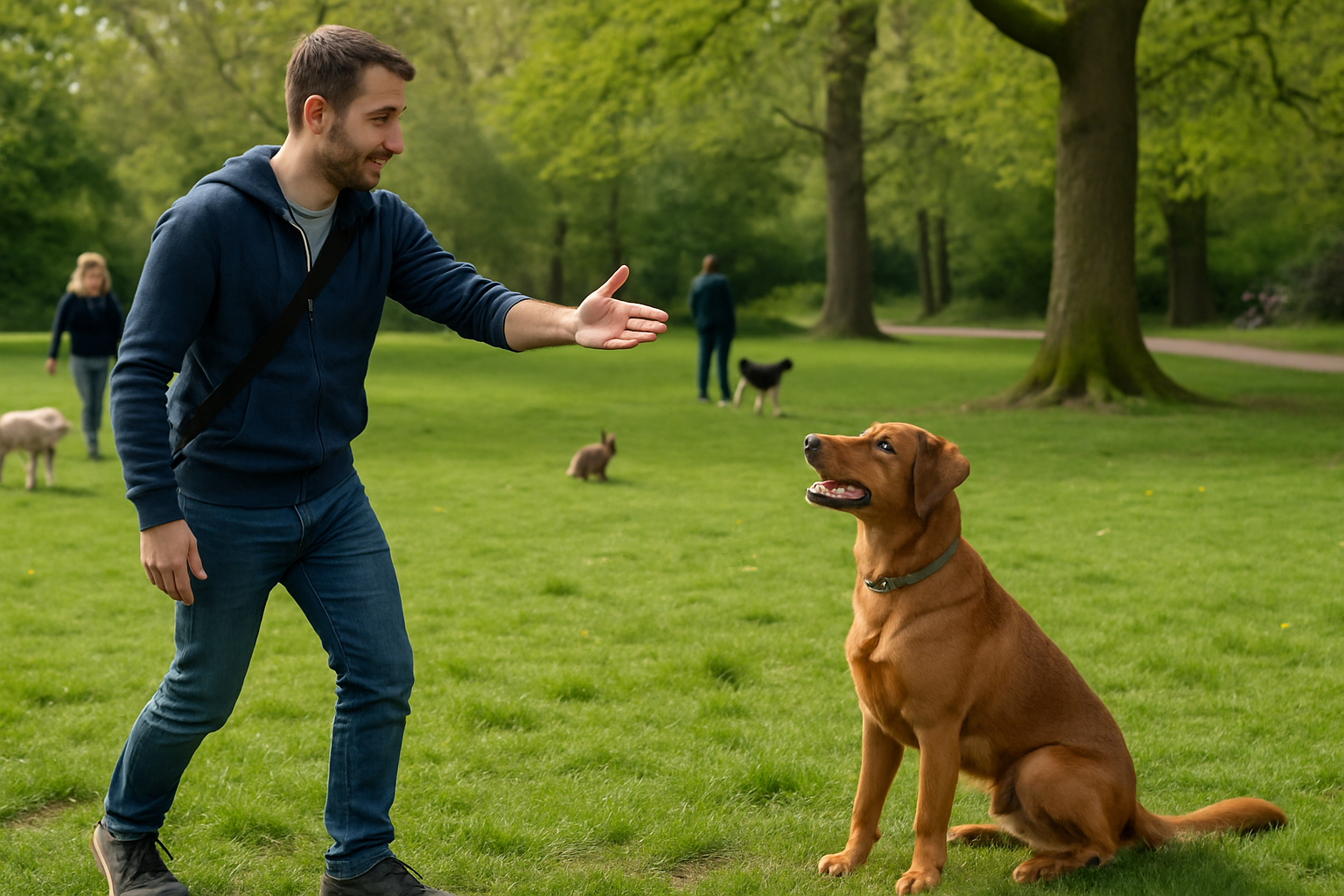
Master Recall Training in Distracting Environments: The Complete Guide
Picture this: You're at the dog park, your pup is having a blast, and you decide it's time to head home. You call out the recall command with confidence—but your dog doesn't even glance your way. Instead, they're completely absorbed in chasing a squirrel or sniffing an invisible scent trail. Sound familiar?
This scenario plays out countless times daily for frustrated dog owners everywhere. The confusing part? That same dog responds flawlessly when called inside your living room. The difference isn't stubbornness or selective hearing—it's the overwhelming power of environmental distractions competing for your dog's attention.
In this guide, we'll explore why recall fails in distracting environments and provide you with a systematic training approach that transforms your dog's responsiveness, whether they're in your backyard or at a bustling dog park.
Why Your Dog "Forgets" Commands in Distracting Environments
Before we jump into solutions, it's important to understand what's actually happening when your dog ignores your recall command outdoors. [2] The answer lies in how dogs process sensory information.
When your dog steps outside, they're immediately bombarded with stimuli: the scent of other animals, the sounds of traffic and birds, the feeling of grass beneath their paws, and visual movement from squirrels, leaves, and other dogs. This sensory overload is fundamentally different from the controlled indoor environment where they trained successfully.
Think of it this way: your dog's brain has a limited attention capacity. When multiple competing stimuli are present, your recall command must be more rewarding than whatever is capturing their focus. [2] If your dog finds a dead fish more exciting than returning to you, or if tracking a scent trail offers more stimulation than your voice, they're not being defiant—they're simply making a choice based on what their brain finds most reinforcing in that moment.
This is crucial to understand because it changes how we approach training. We're not dealing with a behavior problem; we're dealing with a motivation problem. Your dog needs to learn that responding to your recall is more rewarding than any distraction in the environment.
The Poisoned Cue Problem
Before implementing new recall training, we need to address a common issue that may already exist: the poisoned cue. [4]
A poisoned cue is a command your dog has learned to associate with something unpleasant. This happens frequently with the "come" command because owners often call their dogs to do something they dislike—ending playtime, giving medication, getting a bath, or trimming nails.
To determine if your recall cue is poisoned, observe your dog's body language when you say the word:
- Positive response: Your dog bounds toward you with loose, happy movements and an excited expression
- Poisoned response: Your dog slinks slowly toward you, shows tension in their body, or avoids eye contact
- Ignored response: Your dog simply ignores the cue entirely
If your current recall cue is poisoned or has simply lost meaning, the simplest solution is to choose a new word entirely. [4] Common alternatives include "here," "to me," or any consistent word you prefer. The fresh start allows you to rebuild positive associations without the baggage of previous negative experiences.
Building the Foundation: Start Small and Low-Distraction
Reliable recall doesn't happen overnight, and it certainly doesn't develop in chaotic environments. [3] The foundation must be built in controlled settings before you introduce distractions.
Step 1: Choose Your Recall Cue
Select a clear, short word that will be your primary recall command. Consistency across all family members is essential. [4] If one person says "come" and another says "here," your dog receives conflicting messages that slow progress significantly.
Pro tip: Post your chosen cue word in visible areas of your home and share it with anyone who interacts with your dog, including dog walkers and pet sitters.
Step 2: Train in Distraction-Free Environments
Begin training indoors or in empty spaces where your dog can focus entirely on you. [3] Your living room, hallway, or an empty field works perfectly. The goal is to establish that the recall command consistently leads to a rewarding outcome.
Keep initial training sessions short—15 to 20 minutes maximum. [3] Dogs have limited attention spans, and shorter sessions prevent fatigue and maintain enthusiasm.
Step 3: Use High-Value Rewards
Positive reinforcement is the foundation of effective recall training. [3] Your dog must learn that coming when called is the best decision they can make.
High-value rewards might include:
- Premium treats (chicken, cheese, or special training treats)
- Access to a favorite toy
- Enthusiastic praise and physical affection
- A combination of the above
The reward should be more desirable than anything your dog encounters in distracting environments. Save these premium rewards exclusively for recall training—don't use them for other commands.
Progressive Distraction Training: The Systematic Approach
Once your dog reliably responds to the recall cue in low-distraction settings, you're ready to gradually introduce environmental challenges. This is where many owners make mistakes by jumping too quickly to high-distraction scenarios.
The Three-Tier Distraction Protocol
Professional trainers use a structured approach to manage distraction levels. [5] This prevents overwhelming your dog while building confidence and reliability.
Tier 1: Easy Distractions
Begin with minimal environmental stimuli. Examples include:
- An empty plate on the floor (visual distraction, low value)
- Gentle background noise from a distance
- A single toy in the room
- Training in a familiar backyard with no other animals present
Your dog should maintain 90% success rate before progressing. [5]
Tier 2: Moderate Distractions
Once Tier 1 is solid, increase complexity gradually:
- A plate with low-value treats (not their favorites)
- Another person moving quietly in the distance
- Familiar scents or mild environmental sounds
- Training in a backyard with squirrels visible but at a distance
Tier 3: High-Value Distractions
Only progress here once your dog demonstrates consistent success with moderate distractions:
- Their favorite treats or toys on the ground
- Other dogs playing nearby (on-leash initially)
- More intense environmental activity
- Scent trails or squirrels in closer proximity
This graduated approach prevents the frustration of asking your dog to succeed in situations they're not yet ready for. [5]
Combining Verbal and Visual Cues
Relying solely on a verbal command limits your options when your dog can't hear you. [3] Teaching both a verbal cue and a hand gesture provides redundancy and increases reliability.
Develop a consistent hand signal—this might be a wave, a specific gesture, or any movement you can repeat consistently. Train both cues simultaneously so your dog learns they mean the same thing. This is particularly valuable in noisy environments where your voice may not carry clearly.
Training Around Real-World Distractions
After progressing through the three-tier system, you're ready to train in genuinely distracting environments. However, this phase requires specific strategies.
Use a Long Line for Safety and Control
Never practice recall in distracting environments without a long line (15-30 feet) attached to your dog. [5] This allows you to enforce the command if needed while your dog is still learning, preventing them from making poor choices that would reinforce non-compliance.
Start Sessions with Success
Begin each training session with easy recalls your dog will definitely succeed with. This builds momentum and positive associations before attempting more challenging recalls.
Vary Your Rewards
Once your dog shows solid understanding of the command, begin varying your rewards rather than using the same treat every time. [4] This prevents your dog from becoming dependent on seeing a specific reward before responding. Sometimes offer a favorite treat, sometimes enthusiastic praise, sometimes play with a toy. This unpredictability actually strengthens recall because your dog never knows what fantastic reward awaits.
Practice in Multiple Locations
Dogs don't automatically generalize training from one location to another. Your dog may have perfect recall in your backyard but struggle at the dog park. Practice recall in various environments—parks, trails, busy streets (on-leash), and different neighborhoods. This teaches your dog that the recall command means the same thing everywhere.
The Emergency Recall: Your Safety Net
Beyond your regular recall command, consider developing an emergency recall—a separate cue trained to an extremely high standard and reserved for true emergencies. [4]
Your emergency recall cue:
- Uses a completely different word than your regular recall
- Receives intensive initial training
- Is always rewarded with the absolute highest-value reward
- Is used sparingly—only in genuine emergencies
- Maintains its power through consistent, premium reinforcement
This provides a backup option if your regular recall isn't yet reliable enough in a dangerous situation, such as your dog escaping through an open door or bolting toward traffic.
Common Mistakes That Sabotage Recall Training
Understanding what NOT to do is as important as knowing what to do:
Mistake 1: Skipping the Foundation Phase
Jumping directly to distracting environments before establishing solid indoor recall sets you up for failure. Build your foundation thoroughly.
Mistake 2: Using Punishment
Scolding or punishing your dog for not responding to recall creates the very poisoned cue we discussed earlier. [2] This makes the problem worse, not better. Positive reinforcement is scientifically proven to be more effective than aversive methods. [4]
Mistake 3: Calling Your Dog's Name Instead of the Recall Cue
Your dog's name is not a command. Using it as a recall cue confuses your dog and dilutes its effectiveness as an attention-getter. Reserve the recall word specifically for the "come" command.
Mistake 4: Inconsistent Practice
Recall training isn't a one-time activity. Regular, consistent practice—ideally several short sessions weekly—maintains and strengthens the behavior. Sporadic training leads to inconsistent results.
Mistake 5: Skipping the Distraction Tracker
It's easy to think you're progressing systematically when you're actually jumping between difficulty levels. [5] Using a written tracker ensures you're following the protocol consistently and moving forward methodically.
Troubleshooting: When Recall Isn't Improving
If your dog's recall isn't progressing despite consistent training, consider these factors:
- Reward Value: Are your rewards actually more desirable than environmental distractions? Try higher-value treats or rewards your dog rarely receives outside of training.
- Distraction Level: You may be progressing too quickly. Return to an earlier tier and build more thoroughly before advancing again.
- Consistency: Are all family members using the same cue word and training approach? Inconsistency significantly slows progress.
- Poisoned Cue: If your dog shows hesitation or reluctance, your cue may be poisoned. Consider switching to a new word.
- Medical Issues: Hearing loss, pain, or other health conditions can affect recall. Consult your veterinarian if you suspect physical problems.
- Previous Training: If your dog has been trained with aversive methods by a previous owner, rebuilding trust may take longer. Be patient and extra generous with rewards.
Building Long-Term Reliability
Once your dog demonstrates reliable recall in distracting environments, maintenance becomes key. Continue practicing regularly, varying your rewards, and occasionally returning to high-value treats to keep the behavior strong.
Remember that even well-trained dogs can have occasional lapses, especially when exposed to novel distractions or in high-arousal situations. This doesn't mean your training failed—it means your dog is still learning to navigate complex environments. Consistent practice and patience build the reliability that eventually allows you to confidently let your dog off-leash, knowing they'll return when called.
Your Path Forward
Reliable recall in distracting environments is absolutely achievable for any dog. The key is understanding that distractions aren't a behavior problem—they're a motivation problem. By systematically building your dog's understanding of the recall cue, gradually introducing environmental challenges, and maintaining consistent positive reinforcement, you'll develop a recall command that works reliably in any situation.
Start where your dog is ready to succeed, progress gradually, and celebrate small victories along the way. With patience and dedication, that dog who vanishes at the dog park will soon be bounding back to you with enthusiasm, no matter what distractions surround them.
Sources & References
- https://clickertraining.com/what-to-do-when-your-dog-loses-his-cue-training-outdoors-with-distractions/
- https://blog.justfoodfordogs.com/how-to-teach-a-dog-recall.html
- https://www.preventivevet.com/dogs/how-to-teach-your-dog-to-come-when-called
- https://adventuredogsanarchy.com/chais-distraction-recall-training-round-1-1-of-many-today-level-1-in-an-easy-environment/