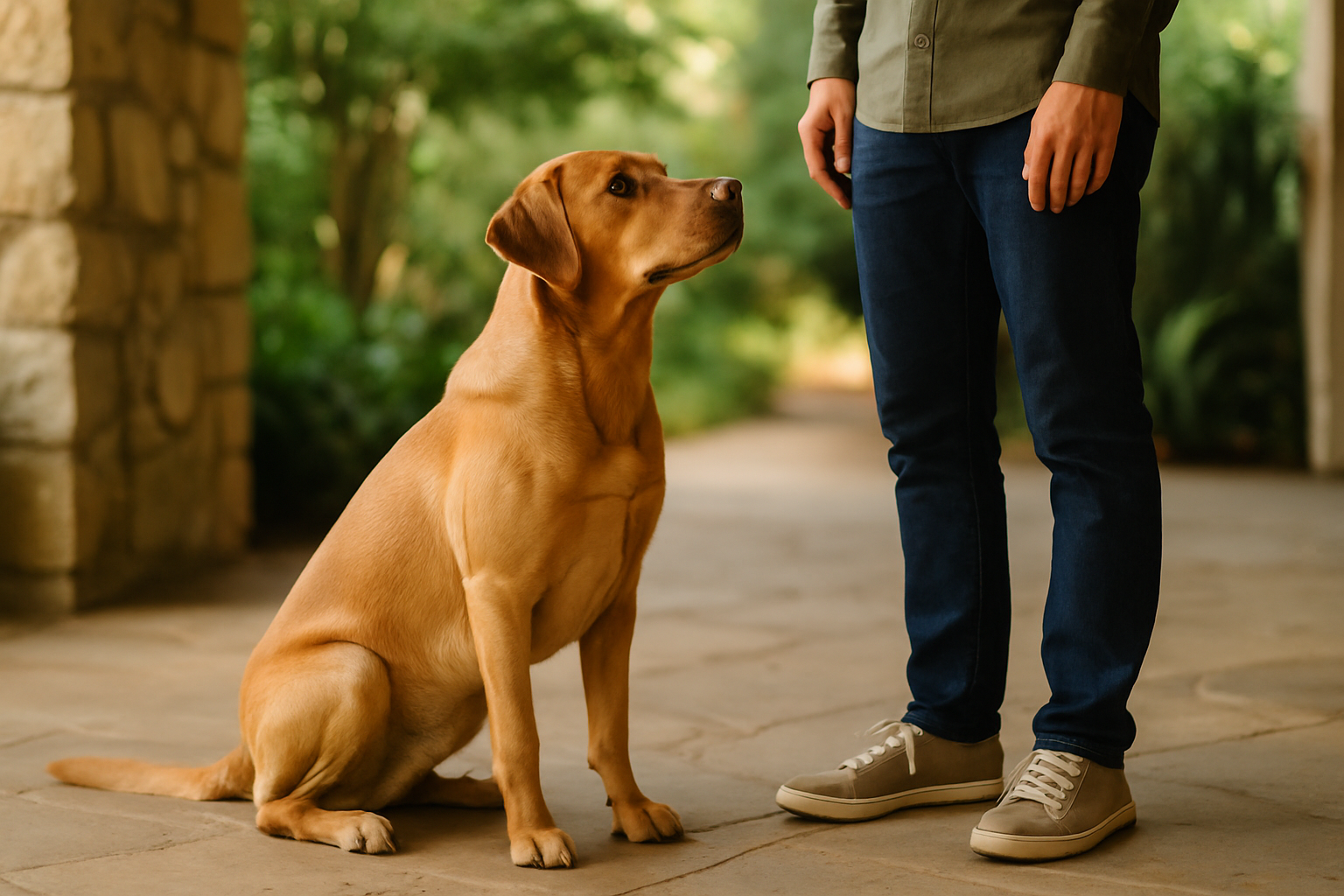
Why the Stay Command Matters More Than You Think
A solid stay command can help prevent dangerous situations. The family dog bolting through an open front door. The puppy lunging toward broken glass on the kitchen floor. The excited pup jumping on visiting grandparents. These scenarios happen in seconds, but a well-trained stay command can stop them in their tracks.
The stay command isn't just about obedience—it's about building impulse control and teaching your dog to look to you for guidance before acting on their natural instincts. [2] This foundation strengthens your relationship and gives you the confidence to navigate real-world situations with your canine companion.
What makes the stay command unique is that it requires your dog to resist their natural urge to follow you or engage with their environment. This mental discipline is more challenging than a simple "sit," which is why the progression from basic duration to impressive distance takes patience, strategy, and consistency.
Understanding the Foundation: Before You Begin
Before diving into duration and distance training, your dog needs to understand what you're asking. This starts with engagement—the most overlooked aspect of command training.
Begin by building your dog's focus on you. Reward eye contact, name recognition, and responsiveness with high-value treats or toys. [1] Practice these engagement exercises in a quiet, distraction-free environment for 5-10 minutes daily. Your dog needs to view you as the most interesting thing in the room before they'll prioritize your commands over external stimuli.
Once your dog demonstrates reliable engagement, introduce the release word. This is critical. Many trainers skip this step, but your dog needs to understand when they're "off duty." Popular release words include "okay," "break," or "free." [1] Without a clear release cue, your dog won't know when the command ends, creating confusion and inconsistency.
The Three Pillars of Stay Command Training
Successful stay training rests on three interconnected elements: position, duration, and distance. Understanding how these work together will accelerate your progress.
- Position: Your dog's physical posture (sit, down, or stand)
- Duration: How long your dog maintains the position
- Distance: How far away you can be while your dog holds the position
The mistake most owners make is trying to increase all three simultaneously. This overwhelms your dog and leads to inconsistent results. Instead, master one element at a time, then layer them together.
Step-by-Step: Building Duration First
Duration training teaches your dog to hold a position for increasing lengths of time. This is where most dogs struggle, so starting here builds confidence and foundation strength.
Phase 1: The 3-Second Foundation
Begin with your dog in a sit position on a leash in your quiet training space. Make eye contact, say "stay" in a calm, firm tone, and immediately reward with a treat and enthusiastic praise. Yes, that's it. One second of staying equals one reward.
Repeat this 10-15 times in a session. Your dog will quickly understand that "stay" means "hold this position and wait for your reward." At this phase, you're not asking for duration—you're building the association between the word and the behavior.
Phase 2: Extending to 5-10 Seconds
Once your dog consistently responds to "stay," gradually increase the time before rewarding. Use these progressions:
- Days 1-2: Hold stays for 3 seconds
- Days 3-4: Hold stays for 5 seconds
- Days 5-6: Hold stays for 8 seconds
- Days 7-8: Hold stays for 10 seconds
If your dog breaks the stay, don't punish. Simply reset calmly and try again. [2] Patience is essential here. Each dog has their own learning timeline, and frustration only creates anxiety around training.
Phase 3: Building to 30+ Seconds
Once your dog reliably holds a 10-second stay, begin extending in 5-second increments. At this stage, introduce very subtle movements. Shift your weight. Blink. Move your head slightly. These micro-distractions prepare your dog for real-world scenarios where you won't be statue-still.
Celebrate small wins. When your dog holds a 15-second stay without breaking, that's progress worth rewarding enthusiastically. This positive reinforcement builds motivation and confidence.
Phase 4: Extended Duration (1-5 Minutes)
Once your dog masters 30-second stays, you can extend to longer periods. However, at this stage, introduce the "wait" concept—a more precise version of stay that's particularly useful for threshold control. [5] The wait command teaches your dog to remain on one side of a physical boundary until released, which is more practical than indefinite sitting.
For extended stays, use a comfortable mat or bed. This gives your dog a designated area and makes longer holds more sustainable, especially for senior dogs or those with joint issues. [2]
Step-by-Step: Building Distance
Distance training teaches your dog to maintain position even when you're not immediately nearby. This is where the stay command becomes truly powerful.
Phase 1: One Step Away
With your dog in a sit and on a loose leash, say "stay" and take one deliberate step backward. Pause for 2-3 seconds, then step back to your dog and reward. Repeat this 10 times.
The key word here is "loose." A tight leash creates tension and suggests you're worried your dog will break. A loose leash communicates confidence and allows your dog to make the right choice independently.
Phase 2: Progressive Distance Increases
Once your dog holds position with you one step away, progress gradually:
- Days 1-2: Two steps away, 3-5 second holds
- Days 3-4: Three steps away, 5-10 second holds
- Days 5-7: Five steps away, 10-15 second holds
- Days 8-10: Across the room, 15-20 second holds
The critical element is consistency. If your dog breaks the stay, calmly return and reset. Never chase or call your dog during this phase—this reinforces breaking the command. Instead, silently return to your dog, reset the stay, and continue.
Phase 3: Out of Sight Distance
This is advanced training. Only progress here after your dog reliably holds stays across a room. Begin by stepping behind a doorway or wall for just 1-2 seconds, then immediately return and reward. Gradually extend the time you're out of sight.
Many trainers skip this phase, but it's invaluable for real-world situations like preventing door bolting or keeping your dog calm during veterinary visits.
Combining Duration and Distance: The Advanced Protocol
Once your dog masters duration and distance separately, combine them strategically. Use this pyramid approach:
- Short duration (5 seconds) + Close distance (1 step): Master this first
- Medium duration (10 seconds) + Medium distance (5 steps): Build next
- Long duration (30 seconds) + Close distance (1 step): Practice this variation
- Medium duration (15 seconds) + Far distance (across room): Challenge this combination
- Long duration (60 seconds) + Medium distance (10 steps): Advanced work
Each combination requires practice. Don't assume that because your dog can do 60-second stays OR 10-step distances that they can do both simultaneously. Train each combination deliberately.
Critical Training Principles for Success
Choose the Right Motivator
Finding what truly motivates your individual dog is non-negotiable. [2] For most dogs, high-value treats work best—small pieces of chicken, cheese, or commercial training treats. Some dogs respond better to toy play or physical affection.
If you're concerned about calorie intake, use low-calorie alternatives like ice chips, small pieces of apple, or even their regular kibble. The reward doesn't need to be extravagant; it needs to be something your dog genuinely wants in that moment.
Master the Release Cue
Your release word is as important as the stay command itself. [1] When you say "okay" or "break," your dog should understand they're now free to move. Make this transition clear and consistent. Always use the same word, deliver it enthusiastically, and reward the movement away from the stay position.
Without a clear release, dogs often break the stay on their own terms, which undermines the entire command's purpose.
Practice in Varied Environments
Your dog's stay command will be most reliable if you practice in multiple locations. [2] Start in your quiet living room, then progress to:
- Your backyard
- A quiet park
- A busier outdoor location
- Different rooms in your home
- Your car
Each new environment presents fresh distractions. Your dog must relearn that "stay" means the same thing regardless of location. This generalization takes time but is essential for real-world reliability.
Gradual Distraction Introduction
Once your dog masters duration and distance in a quiet environment, strategically introduce distractions. Start subtle—drop a toy nearby, have someone walk past. Progress to more challenging scenarios—other dogs, squirrels, or food on the ground.
Never introduce distractions too quickly. If your dog consistently breaks during distraction training, you've increased difficulty too fast. Return to a quieter environment and rebuild.
Common Mistakes That Sabotage Progress
Progressing Too Quickly: The most frequent error is increasing duration and distance simultaneously or too rapidly. Your dog needs time to build confidence at each level. Slow progress creates fast, reliable results.
Inconsistent Rewards: If you reward the stay sometimes but not always, your dog won't understand why consistency matters. Early in training, reward every successful stay. Later, you can use variable rewards, but initially, consistency is key.
Unclear Communication: Vague hand signals and uncertain vocal tone confuse dogs. Your "stay" command should be clear, firm, and consistent. Your hand signal (often a flat palm) should be the same every time.
Ignoring Senior Dog Needs: Older dogs can absolutely learn stay commands, but they may have physical limitations. [2] Consider their comfort, use supportive mats, and keep sessions shorter. Accommodate vision or hearing issues with visual signals or light touches.
Real-World Applications: When Stay Truly Matters
Understanding why you're training stay keeps motivation high. Here are practical scenarios where this command becomes invaluable:
- Door Safety: Preventing your dog from bolting when the front door opens
- Emergency Response: Keeping your dog away from hazards like broken glass or spilled medications
- Social Situations: Maintaining calm during visitor arrivals or family gatherings
- Veterinary Visits: Reducing anxiety and improving cooperation during examinations
- Off-Leash Recall: Building foundation for reliable recall in open spaces
- Impulse Control: Teaching your dog to pause and look to you before reacting
Training Timeline: What to Expect
Every dog learns at their own pace, but here's a realistic timeline for most dogs:
- Weeks 1-2: Basic stay understanding, 5-10 second holds, 1-2 step distance
- Weeks 3-4: 15-30 second holds, 5-10 step distance
- Weeks 5-8: 1-2 minute holds, across-room distance, some distraction tolerance
- Weeks 9-12: 2-5 minute holds, multiple room distances, reliable with moderate distractions
- Months 4+: Refined stays with real-world reliability
Puppies under five months may require more time and consistency. [5] Adult dogs often progress faster, while senior dogs may need adapted approaches. Don't compare your dog's timeline to others—focus on incremental progress.
Troubleshooting Common Challenges
Your Dog Keeps Breaking the Stay
If your dog consistently breaks before you release them, you've likely increased difficulty too quickly. Return to shorter durations or closer distances. Also evaluate your reward timing—are you rewarding before your dog has a chance to break? Sometimes rewarding during the stay, rather than only at the end, helps.
Your Dog Seems Anxious During Stays
Anxiety during stay training often indicates you're asking for too much too soon. Reduce duration and distance significantly. Use a comfortable mat and practice in a safe, familiar space. If anxiety persists, consult a certified professional trainer or veterinary behaviorist.
Your Dog Responds in Some Environments but Not Others
This is completely normal. Your dog hasn't generalized the command yet. Practice the stay command in multiple environments, starting with easier locations and progressing to more challenging ones. Each new location requires retraining.
Your Dog Responds to You but Not Your Family Members
Have family members practice the stay command using the same techniques you've used. Each person needs to establish their own training relationship and consistency with your dog.
Taking It Further: Advanced Stay Variations
Once your dog masters basic stay with duration and distance, you can explore advanced variations:
- Down-Stay: More challenging than sit-stay because the down position is naturally more relaxing
- Stay with Distractions: Practicing with other dogs, toys, or food present
- Group Stay: Multiple dogs staying in proximity
- Threshold Wait: Staying behind doors, gates, or boundaries [5]
- Moving Stay: Your dog maintaining position while you move around them
Your Action Plan: Starting Today
Ready to transform your dog's stay command? Here's your immediate action plan:
- Choose your training location—quiet, familiar, distraction-free
- Identify your dog's highest-value motivator
- Select your release word and practice it consistently
- Start with 5-minute training sessions, 2-3 times daily
- Focus exclusively on duration for the first week
- Progress to distance work in week two
- Track your progress in a training journal
- Celebrate small wins—they're the building blocks of success
Remember, the stay command isn't about dominance or control—it's about building communication, trust, and safety between you and your dog. Every training session strengthens your bond and gives your dog the mental exercise they crave. Approach each session with patience, consistency, and genuine enthusiasm for your dog's progress.
The dog who waits at the open door, stays calm during chaos, and looks to you for guidance isn't just well-trained—they're a confident, secure companion who trusts you completely. That's the true power of mastering the stay command.