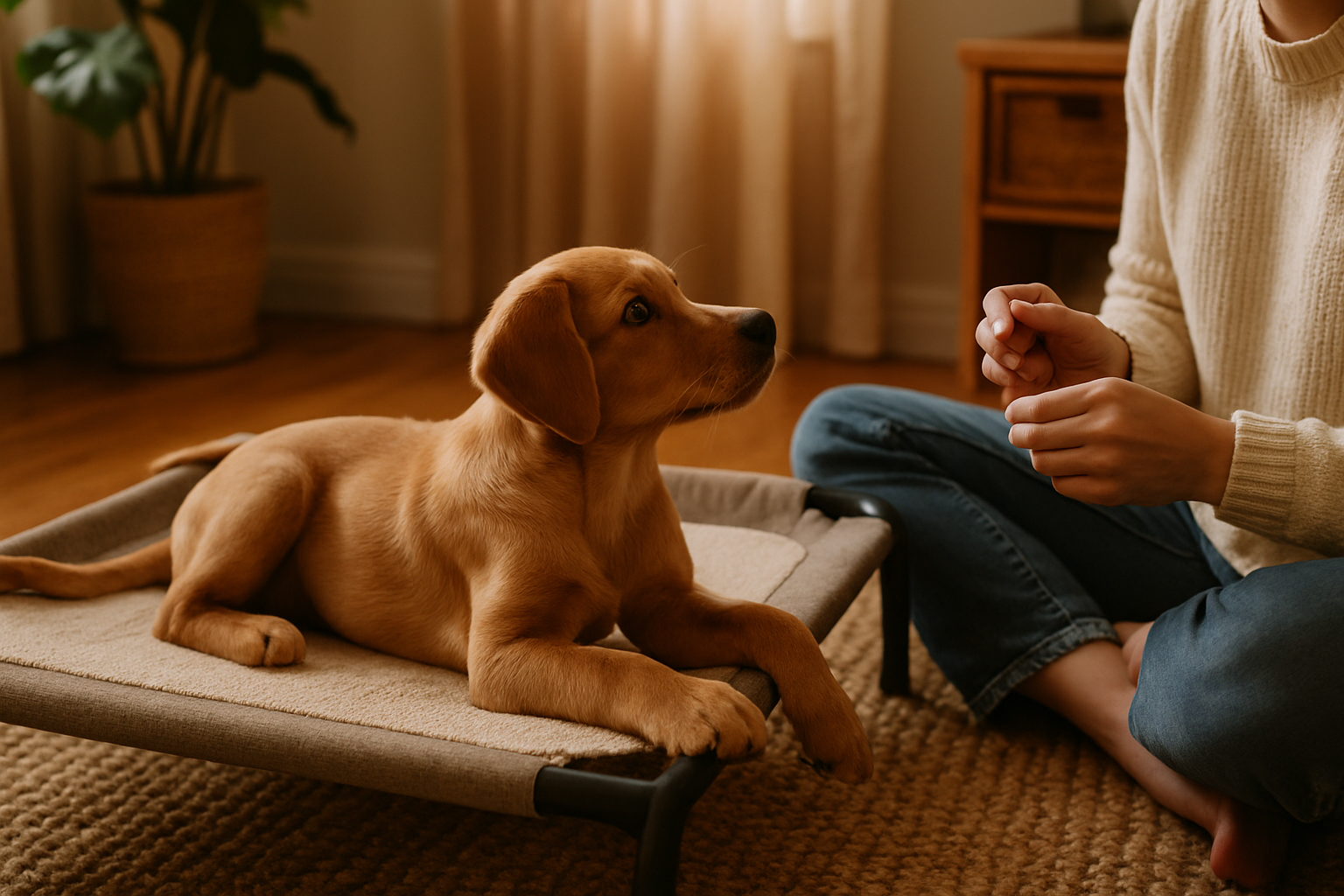
Why the Place Command Matters for Your Puppy
If you've ever wished your puppy would simply settle down on command, you're not alone. The place command—also called the "go to bed" command—is fundamentally about teaching your puppy how to be calm when life happens around them. It's not just about obedience; it's about giving your puppy a safe, predictable refuge while helping you maintain peace in your home. [1]
This command becomes invaluable in real-world situations: when guests arrive at your door, during family gatherings, when you're cooking dinner, or even when you need to establish boundaries. Unlike simply closing a door or using a crate, the place command teaches your puppy to make the choice to settle, building confidence and emotional regulation that lasts a lifetime.
Choosing the Right "Place" for Your Puppy
Before you begin training, you need to select an appropriate target location. This is more important than many new puppy owners realize, because puppies don't naturally generalize commands—they need to learn what "place" means through clear, visual cues. [1]
The best options include:
- Elevated dog beds: The raised design creates a distinct boundary that helps puppies understand exactly where they should be. The different texture and height make it stand out from regular floor space. [4]
- Pet cots: Similar to elevated beds, these provide clear visual and tactile distinctions that accelerate learning.
- Yoga mats or bath mats: If elevated beds aren't available, textured mats work well as long as they're noticeably different from your regular flooring.
- Dog cots: These portable options are excellent if you plan to practice place training in multiple locations.
Pro tip: Avoid using your puppy's regular sleeping area as their training place initially. Having a dedicated training bed helps your puppy understand the distinction between casual napping and the formal "place" command. [4]
Step-by-Step Training Process
Phase 1: Building Initial Interest
Your first goal is simply getting your puppy excited about their designated bed. This foundation phase requires patience and positive associations.
- Start close: Begin training with your puppy on a leash and harness, standing near the bed. This gives you gentle guidance options without force.
- Use a food lure: Hold a small treat near the bed to encourage your puppy to investigate and eventually step onto it.
- Say the command: As your puppy moves toward the bed, say "Place" or "Bed" in a clear, consistent voice. Use their name first to capture attention.
- Mark the behavior: The moment all four paws touch the bed, enthusiastically say "YES! Good place!" to mark the exact behavior you're rewarding. [4]
- Reward immediately: Offer a small nibble of the treat—not a full treat, just enough to create positive association. Follow this with genuine affection: scratches, pats, and verbal praise. [4]
Repeat this sequence 5-10 times per training session. Keep sessions short (5-10 minutes) to maintain enthusiasm and prevent boredom.
Phase 2: Building Distance and Independence
Once your puppy reliably moves to their place, gradually increase the challenge by creating distance between you and the bed.
- Increase your distance: After several successful repetitions, take a small step backward before giving the command. Gradually increase this distance over multiple sessions.
- Drop the leash: As your puppy becomes more confident, allow the leash to drop to the ground. You're still nearby for guidance, but your puppy is making independent choices.
- Use the come command: Say your puppy's name and "Come," then immediately follow with "Place" as they approach the bed. This chains commands together and builds a stronger foundation. [1]
- Vary your position: Practice from different angles and distances to prevent your puppy from becoming dependent on your specific positioning.
Phase 3: Adding Complexity with Place Patterning
Once your puppy confidently goes to one place, introduce place patterning—a game-like routine that teaches your puppy to understand "place" applies to multiple locations, not just one specific bed. This is crucial because puppies don't automatically transfer learning from one context to another. [1]
Here's how place patterning works:
- Set up two targets: Position two different elevated beds or mats in your training area, several feet apart.
- Direct to first place: Use the "Come" command to direct your puppy to the first bed, then say "Place." Reward when they're fully on it.
- Add obedience commands: Once on their place, ask for "Sit," then "Down." Mark each correct response and reward with a small treat. [1]
- Transition to second place: Say your puppy's name and "Come" to redirect them from the first bed to the second bed, repeating "Place" as they approach.
- Repeat the sequence: Ask for "Sit" and "Down" on the second bed, then reward.
- Vary the pace: Mix up how quickly you move between places to keep it feeling like a game rather than a rigid routine. [1]
Practice this 5-10 times per session. As your puppy masters this, they'll begin to understand that "Place" means "go to any designated spot and settle," not just one specific bed.
Adding Duration: The Stay Component
As your puppy becomes comfortable with the basic place command, you can extend how long they remain in place before being released or called away. This builds impulse control and genuine calmness.
- Start with the basics: Lure your puppy onto their place and ask for "Sit," then "Down."
- Introduce stay: Hold your palm up in a flat hand signal and say "Stay" in a calm, confident voice.
- Create distance: Take a few steps backward while maintaining your hand signal. Your puppy should remain in place.
- Return and release: After just 5-10 seconds initially, return to your puppy, mark the behavior with "Good!" and reward.
- Gradually extend time: Over multiple training sessions, slowly increase the duration before returning to reward. Add only 2-3 seconds at a time to prevent frustration.
Remember: it's better to end on success with short durations than to push too hard and create frustration.
Managing Common Training Challenges
Your Puppy Is Afraid of the Elevated Bed
Some puppies, particularly smaller breeds, feel intimidated by raised surfaces. Here are solutions: [4]
- Flip the elevated bed over so it sits flat on the ground, removing the raised component.
- Stand on the bed yourself with your puppy to normalize it as a safe space.
- Walk across the bed with your puppy to demonstrate it's stable and secure.
- Use extra-high-value treats to build positive associations.
Your Puppy Won't Stay on the Place
If your puppy keeps jumping off before you've finished the command sequence:
- You're likely asking for too much too soon. Return to shorter durations.
- Ensure you're using a leash for gentle guidance if needed.
- Increase the value of rewards—use higher-value treats temporarily.
- Practice in lower-distraction environments before adding complexity.
Your Puppy Doesn't Understand the Command in New Locations
This is completely normal and expected. Since puppies don't generalize commands naturally, practice place training in different rooms of your house and eventually in your yard. [1] Start with the same bed or mat in each location so the visual cue remains consistent, then gradually introduce different place targets once your puppy demonstrates understanding.
Weaning Off Food Rewards
Eventually, you'll want to transition from constant food rewards to intermittent reinforcement. However, timing matters significantly. [1]
Only begin this transition when your puppy has demonstrated a strong, reliable grasp of the command. Here's the progression:
- Intermittent rewards: Ask your puppy to perform the command 2-3 times before offering a treat.
- Increase requirements: Gradually build toward requiring your puppy to complete multiple repetitions of the full place routine before receiving a reward.
- Add non-food rewards: Incorporate praise, petting, play time, or access to toys as rewards alongside or instead of treats.
- Maintain unpredictability: Don't reward every command equally—this unpredictability actually strengthens the behavior.
Taking It to the Next Level: The 3 D's of Training
Once your puppy masters basic place training, you can add complexity through three dimensions: [1]
- Distance: Increase the distance between you and your puppy when giving the command. Can they go to their place from across the room? The other room? The yard?
- Duration: Extend how long they remain in place before being released or called away.
- Distractions: Practice place training with increasing environmental distractions—other people present, toys visible, other dogs nearby, outdoor sounds.
Add only one dimension at a time. If you increase distance, keep duration short. If you're working on duration, keep distractions minimal. This prevents overwhelming your puppy and maintains success rates.
Real-World Applications for Your Puppy
The place command transforms everyday situations:
- Visitor arrivals: Instead of a jumping, excited puppy, send them to their place when guests arrive.
- Meal preparation: Keep your puppy safely out of the kitchen while you cook.
- Work-from-home management: Create boundaries during important calls or meetings.
- Travel preparation: Puppies comfortable with place commands adapt better to new environments.
- Multi-dog households: Manage each dog's space and reduce resource guarding behaviors.
Key Takeaways for Success
Teaching the place command requires consistency, patience, and understanding of how puppies learn. Remember these fundamental principles:
- Start with a clearly defined, visually distinct target area.
- Use consistent language and hand signals every single time.
- Build duration and distance gradually—rushing creates failure.
- Puppies don't generalize, so practice in multiple locations with different targets.
- Place patterning accelerates understanding by teaching the concept across multiple contexts.
- Reward immediately and specifically to mark the exact behavior you want.
- Keep training sessions short, fun, and successful.
The place command is genuinely one of the most valuable skills you can teach your puppy. It creates calm, predictable behavior while building your puppy's confidence and emotional regulation. With consistent practice and patience, your puppy will learn to view their designated place as a safe, rewarding refuge—transforming chaotic moments into peaceful ones.
Sources & References
- https://www.thepuppyacademy.com/blog/2021/3/8/puppy-training-101-teaching-your-puppy-place-command-routines
- https://www.mainedogtrainer.com/blog/the-place-command-is-excellent-obedience-and-behavioral-exercise-part-1-of-the-command-series
- https://www.upstatecanine.com/blog/how-to-teach-your-dog-the-go-to-bed-command/