Why Hand Targeting Matters for Your Dog
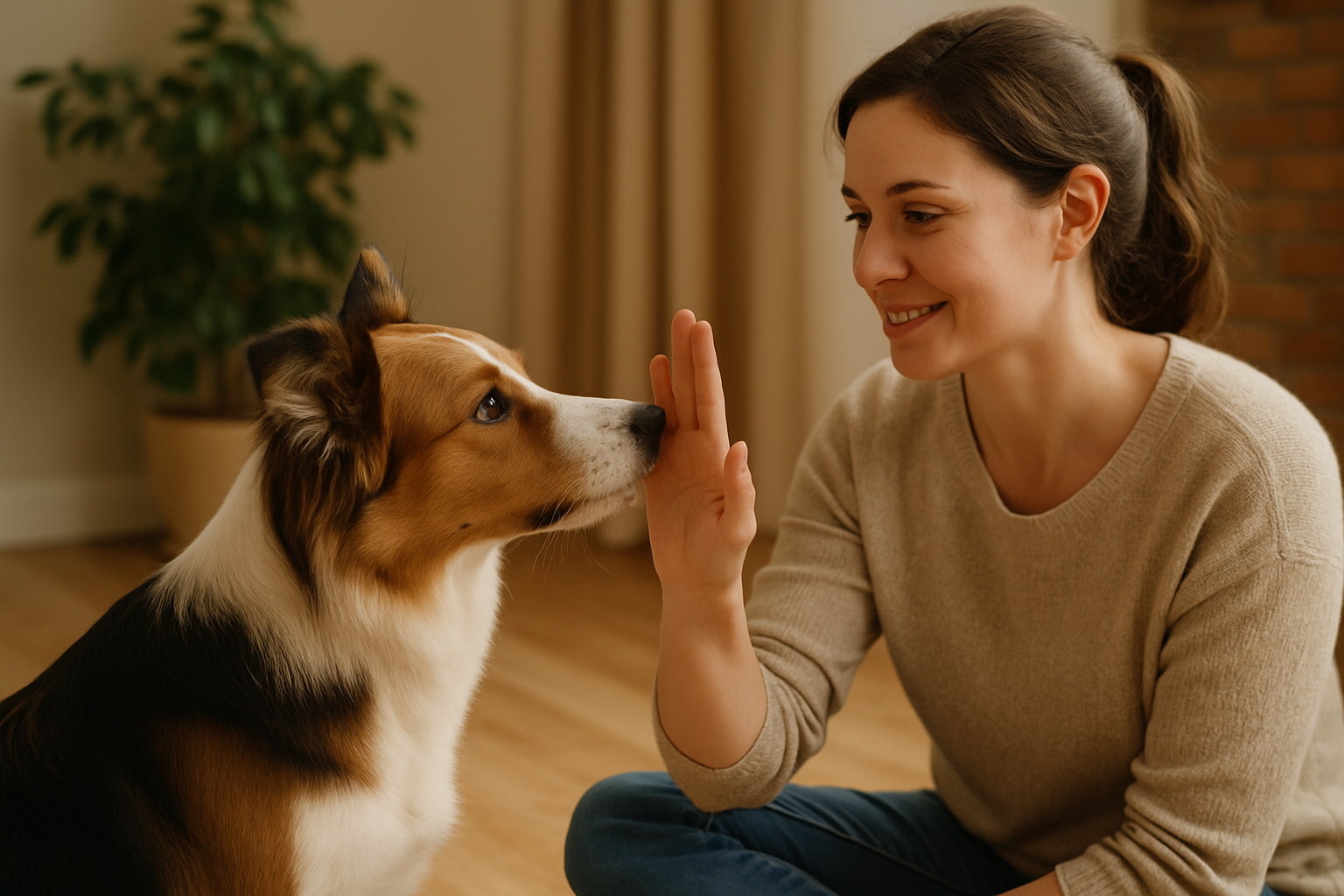
If you're looking for a single behavior that transforms how you interact with your dog, hand targeting deserves your attention. This simple yet powerful skill—where your dog learns to touch their nose to your hand when you give a cue—serves as a gateway to countless training possibilities and real-world applications. [5]
Unlike traditional commands that can feel restrictive, hand targeting is built on cooperation and choice. Your dog actively decides to engage with you, which builds confidence and strengthens your bond. Whether you have a nervous rescue dog, a rambunctious puppy, or a well-trained adult dog, this behavior adapts to meet your specific needs.
The beauty of hand targeting lies in its versatility. It's not just another command to add to your repertoire—it's a foundation that supports nearly every other training goal you might have.
Understanding Hand Targeting: More Than Just a Trick
Hand targeting belongs to a broader category of training called "targeting," which involves teaching your dog to use a specific body part to make contact with an object or location. [2] While nose-to-hand targeting is the most common form, this principle extends to chin targeting, back foot targeting, shoulder targeting, and even teaching your dog to go to specific locations like their bed or a designated training station.
What makes targeting so valuable is that it gives you the ability to direct your dog's body and attention through cooperation rather than force. Your dog learns what you want them to do, consents to do it, and maintains control over their own choices throughout the process. [2]
This approach is particularly transformative for nervous or fearful dogs. Instead of feeling pressured or forced into situations, they can build confidence gradually through positive reinforcement and their own agency.
The Foundation: Why Nose Targeting Works Best
While you could teach your dog to target with various body parts, nose targeting serves as the ideal foundation for several practical reasons:
- Natural behavior: Dogs naturally investigate the world with their noses, so you're building on an instinct they already possess
- Accessibility: Your hand is always with you, making practice opportunities abundant
- Clarity: The behavior is unmistakable—there's no ambiguity about whether your dog performed it correctly
- Scalability: Once mastered, you can teach your dog to target other objects, people's hands, or specific locations
- Inclusivity: For people with mobility challenges or dogs with hand sensitivity, you can substitute the target with a wooden spoon, target stick, or other object. [2]
Getting Started: Essential Tools and Setup
Before you begin training, gather a few simple items and set up your environment for success:
- High-value treats: Choose rewards your dog absolutely loves—small pieces work best to keep training sessions moving quickly
- A marker: This is crucial for clear communication. Your marker can be a clicker, the word "yes," or even a thumbs-up gesture for deaf dogs. [2] The marker tells your dog precisely when they've done something right
- A quiet space: Start in a low-distraction environment like your living room or a quiet backyard
- Your hand: That's it—your open palm or extended fingers are your primary training tool
The marker is particularly important because it bridges the gap between the moment your dog performs the behavior and when you deliver the reward. This clarity accelerates learning dramatically.
Step-by-Step Training Method
Step 1: Create Curiosity
Begin by simply presenting your open hand near your dog's face—roughly 6-12 inches away. Most dogs will naturally investigate your hand by sniffing or moving toward it. The moment their nose makes contact with your palm, mark the behavior and immediately reward with a treat. [2]
During these initial sessions, you're not using a verbal cue yet. You're simply rewarding the natural behavior of nose-to-hand contact. This helps your dog understand what action earns rewards.
Step 2: Build Consistency
Repeat this process multiple times during short training sessions (5-10 minutes). Your dog will quickly realize that touching their nose to your hand results in rewards. You'll likely notice their enthusiasm increasing—they'll start actively seeking out your hand rather than passively responding to it.
At this stage, vary your hand position slightly. Move it a few inches to the left or right, up or down. This teaches your dog to reach for your hand rather than assuming it will always be in the exact same spot.
Step 3: Introduce the Verbal Cue
Once your dog is consistently touching their nose to your hand, introduce your chosen cue word. "Touch" is the most common choice, though you can use any word that feels natural to you. [2]
Say the word clearly just before presenting your hand. When your dog touches their nose to your palm, mark and reward. Repeat this sequence until your dog begins to anticipate the hand presentation when they hear the cue.
Step 4: Increase Distance Gradually
As your dog becomes reliable with the behavior, begin presenting your hand at slightly greater distances. Start with just a few inches farther away, then gradually increase the distance over multiple training sessions. This teaches your dog to actively move toward your hand rather than simply reacting when it's already close.
Step 5: Generalize Across Locations
Dogs don't naturally generalize skills across different environments. A behavior your dog knows perfectly in your living room might not transfer to the backyard or a park without specific practice. [2]
Once your dog is reliable at home, practice the behavior in different rooms, then outside, then in increasingly distracting environments. When you change locations, make the exercise easier by presenting your hand closer again, then gradually increase difficulty as your dog builds confidence.
Critical Training Mistakes to Avoid
Don't Force the Behavior
Never push your dog's nose toward your hand or physically guide them into position. Your dog's nose is highly sensitive, and forced contact teaches them that hands are something to avoid rather than seek out. [2] The entire purpose of this training is to teach your dog that they choose to engage with you.
Don't Tap or Tap Your Dog's Nose
Your dog's nose is remarkably sensitive and doesn't enjoy being tapped or bopped. Even well-intentioned tapping can discourage your dog from wanting to touch your hand. [2] Let your dog's nose come to your hand naturally.
Don't Neglect the Marker
The marker is your communication bridge. Without it, your dog might not understand exactly which action earned the reward. Be consistent with your marker—use it every single time the behavior occurs correctly.
Don't Rush the Process
Training is a marathon, not a sprint. Some dogs learn hand targeting in a few sessions, while others need more time. Patience and consistency matter far more than speed.
Real-World Applications: How Hand Targeting Transforms Training
Enhanced Recall
Hand targeting can become a powerful recall command, especially for dogs that don't respond reliably to "come." Some dogs are naturally more motivated by the specific action of targeting your hand than by the abstract concept of returning to you. [5] You can even combine cues by saying "come touch!" to create a super-reliable recall command.
Building Confidence in Nervous Dogs
For rescue dogs or dogs with anxiety around hands and strangers, hand targeting offers a controlled way to build positive associations. Rather than forcing interaction, you're inviting your dog to choose engagement. This is particularly valuable when introducing your dog to new people—instead of having strangers reach for your dog, they can present their hand and let your dog initiate the interaction. [5]
This approach gives nervous dogs agency and control, which significantly reduces stress and builds confidence over time.
Redirecting Unwanted Behavior
Hand targeting serves as an excellent redirect for reactive or overstimulated dogs. If your dog is fixating on another dog, a squirrel, or becoming too rambunctious, calling them to touch your hand redirects their focus back to you and interrupts the problematic behavior pattern. [5]
Teaching Polite Greetings
Puppies and untrained dogs often jump on people or use their mouths during greetings. Hand targeting teaches them to target your hand with their nose instead. This is particularly useful in family settings—children can play "pass the puppy," where each child calls the puppy to touch their hand in sequence. The puppy learns to rush toward hands rather than bodies, preventing the "body-checking" behavior that can be problematic with children. [5]
Positioning for Practical Tasks
Hand targeting helps you position your dog for necessary tasks like opening doors toward them, getting their head through a collar or head halter, or moving them out of the way. [5] Instead of pushing or pulling, you're guiding them with a behavior they enjoy.
Building Environmental Confidence
Some dogs are anxious about new objects or unusual situations. You can turn hand targeting into a confidence-building game by asking your dog to touch new objects during walks. This helps them realize that unfamiliar things aren't threatening. [5] Over time, this dramatically reduces environmental anxiety and builds a more confident, resilient dog.
Advanced Applications and Fun Variations
Once your dog masters basic hand targeting, you can expand the behavior in creative directions:
- Nose-to-nose kisses: Teach your dog to touch their nose to your nose for an adorable trick
- Object targeting: Transfer the behavior to other objects like a target stick, wooden spoon, or specific toys
- Location targeting: Teach your dog to go to their bed, mat, or a specific station using the same principles
- Multi-person targeting: Have multiple family members practice so your dog will target any family member's hand
- Distance challenges: Play hide-and-seek games where family members call the dog and ask for a touch
Troubleshooting Common Challenges
My Dog Isn't Interested in Touching My Hand
If your dog shows little interest, try these solutions:
- Use higher-value treats—find something your dog is absolutely obsessed with
- Practice when your dog is hungry and more food-motivated
- Make your hand more interesting by putting a small dab of peanut butter or wet food on your palm
- Try training in a more stimulating environment where your dog is naturally more active
- Ensure your marker is clear and immediate—the timing matters tremendously
My Dog Keeps Jumping or Getting Overexcited
If your dog becomes too enthusiastic:
- Present your hand lower, at nose height rather than high
- Use a lower-value treat to reduce excitement levels
- Take breaks between repetitions to let your dog calm down
- Practice in a less stimulating environment
- Reward calm touches more heavily than excited ones
My Dog Is Hand-Shy or Afraid
For dogs with hand sensitivity or fear:
- Start with a target stick or wooden spoon instead of your hand [2]
- Move even more slowly, giving your dog time to build confidence
- Never force contact—let your dog approach at their own pace
- Reward heavily for any progress, no matter how small
- Consider working with a professional trainer experienced with fearful dogs
Training Timeline: What to Expect
Most dogs learn basic hand targeting relatively quickly, though individual timelines vary:
- Sessions 1-3: Your dog begins making nose-to-hand contact consistently
- Sessions 4-7: You introduce the verbal cue and your dog begins anticipating the behavior
- Sessions 8-15: Your dog responds reliably to the cue at varying distances
- Weeks 2-4: You generalize the behavior across different locations and contexts
Dogs genuinely enjoy this exercise, so progress typically happens faster than with many other behaviors. [2]
Key Takeaways for Success
Hand targeting represents one of the most valuable investments you can make in your dog's training foundation. Here's what matters most:
- Start simple: Let your dog's natural curiosity drive the initial learning
- Use a clear marker: Precise communication accelerates learning dramatically
- Never force the behavior: Cooperation and choice are what make this training so powerful
- Generalize systematically: Practice in multiple locations and contexts to build real-world reliability
- Keep sessions short and positive: Brief, successful training builds enthusiasm and prevents frustration
- Recognize the broader value: This isn't just a trick—it's a tool that transforms how you communicate with your dog
Whether you're working with a nervous rescue dog building confidence, a puppy learning polite behavior, or an adult dog expanding their skills, hand targeting offers immediate practical benefits and opens doors to advanced training possibilities. Start today, keep sessions short and positive, and watch as your dog enthusiastically engages with you in this simple yet transformative behavior.