Why Loose Leash Walking Matters (More Than You Think)
If you're a new puppy owner, you've probably experienced that moment: you clip on the leash, step outside, and suddenly your adorable pup transforms into a furry freight train, pulling relentlessly toward every smell, leaf, and passing stranger. You're not alone—and more importantly, your puppy isn't being stubborn or trying to dominate you.
Your puppy pulls because it works. From their perspective, pulling gets them to interesting places faster. When your pup pulls toward a lamppost and you follow, they've learned a valuable (but unwanted) lesson: pulling achieves the goal. [1] This isn't a dominance issue—it's simple cause and effect from a dog's point of view.
But here's why teaching loose leash walking matters beyond just pleasant walks:
- Safety: A dog pulling unpredictably can dart into traffic, tangle around other dogs, or knock over children
- Neck health: Constant pulling against a collar can raise eye pressure and strain delicate neck structures [1]
- Bonding: Enjoyable walks strengthen your relationship with your puppy
- Consistency: Dogs that learn loose leash walking early are less likely to develop pulling habits that become dangerous as they grow
- Mental health: Regular, pleasant walks provide crucial mental and social stimulation [4]
The good news? Loose leash walking is learnable—even if it feels impossible right now. It requires patience, planning, and persistence, but the investment pays dividends for years to come. [4]
Choose the Right Equipment First
Before you even step outside, getting the right gear sets you up for success. The equipment you choose directly affects both your ability to train and your puppy's comfort and safety.
Leashes: What Actually Works
Start with a standard 6 to 10-foot leash made from material that won't cause friction burns if your puppy pulls. [4] The leash should feel comfortable in your hands—not too thin or flimsy—but lightweight enough that your puppy doesn't feel weighted down.
- Avoid retractable leashes: These can cause serious friction burns to both you and your puppy, and they don't give you the control you need for training [4]
- Avoid rope leashes: While stylish, they can be harsh on your hands and your puppy's neck during training
- Best choice: A flat nylon or leather leash, 1/2 to 3/4 inches wide, that feels secure and comfortable to hold
Collars vs. Harnesses: The Safety Question
This is one of the most important decisions you'll make for your puppy's training and long-term health.
If using a collar: Choose a plain, flat collar that fits properly—you should be able to slip two to four fingers between the collar and your puppy's neck. [4] The collar must be snug enough that it can't slip over their head, but not so tight it restricts breathing.
Important consideration: When dogs pull against a collar, the pressure concentrates on the neck. Research has shown that this pressure can significantly raise eye pressure in both long-nosed and short-nosed breeds, even when simply exercising. [1] If your puppy pulls hard, coughs, makes noisy breathing sounds, or physically overpowers you, a collar isn't the right choice.
Harness advantages: A well-fitting H-style or Y-style harness protects your puppy's neck while they learn, since the pressure distributes across the chest and body rather than concentrating on the throat. [1] Look for:
- Proper fit with no rubbing or chafing
- Secure attachment points that won't rotate or twist
- Easy on-and-off design for convenience
- Appropriate sizing for your puppy's current and expected adult size
Critical point: A harness is not a training tool by itself. It protects your puppy's neck, but the actual learning and behavior change still needs to happen through training. [1] Don't expect a harness to magically stop pulling—it's protective equipment that allows you to train safely.
Avoid training collars: Slip collars, choke chains, prong collars, and electronic collars all rely on pain to discourage pulling. These can cause stress, fear, and anxiety—and may trigger aggression. [1] Positive, reward-based training is far more effective and creates a confident, happy puppy. [4]
Understanding Why Your Puppy Pulls: The A-B-C Method
Before you can effectively change your puppy's pulling behavior, you need to understand what's driving it. The A-B-C method helps you decode what's happening. [4]
A = Antecedent (what happens before)
What's the trigger? Is your puppy pulling toward another dog, a smell, a person, or simply forward down the street? Is it happening in busy areas, quiet neighborhoods, or everywhere?
B = Behavior (the pulling itself)
Notice what accompanies the pulling. Is your puppy lunging? Jumping? Whining? Barking? The pulling rarely happens in isolation.
C = Consequence (what happens as a result)
This is the key: from your puppy's perspective, what does pulling accomplish? Does it get them closer to what they want? Do you stop and let them sniff? Do they get attention (even if it's negative attention)?
Example scenario: Your puppy pulls toward another dog. The consequence, from their viewpoint, is getting closer to something they want to interact with. Pulling is working. To change this, you'd need to change the consequence—perhaps by rewarding them for walking calmly past other dogs instead. [4]
Step-by-Step Training: Building Loose Leash Walking
Loose leash walking is complex and requires patience, but breaking it into manageable steps makes it achievable. Consistency matters more than any single technique—if your puppy sometimes gets what they want by pulling, they'll keep trying. [1]
Step 1: Start in a Low-Distraction Environment
Don't begin on a busy street or at the dog park. Start indoors in your home or in a quiet, fenced yard where your puppy has few reasons to pull. [4]
- Clip on the leash and stand quietly
- Wait for even the smallest moment of slack in the leash
- The instant you see slack, mark the behavior with an enthusiastic "Yes!" and immediately deliver a reward [4]
- Practice for just 5 minutes per session—puppies have short attention spans
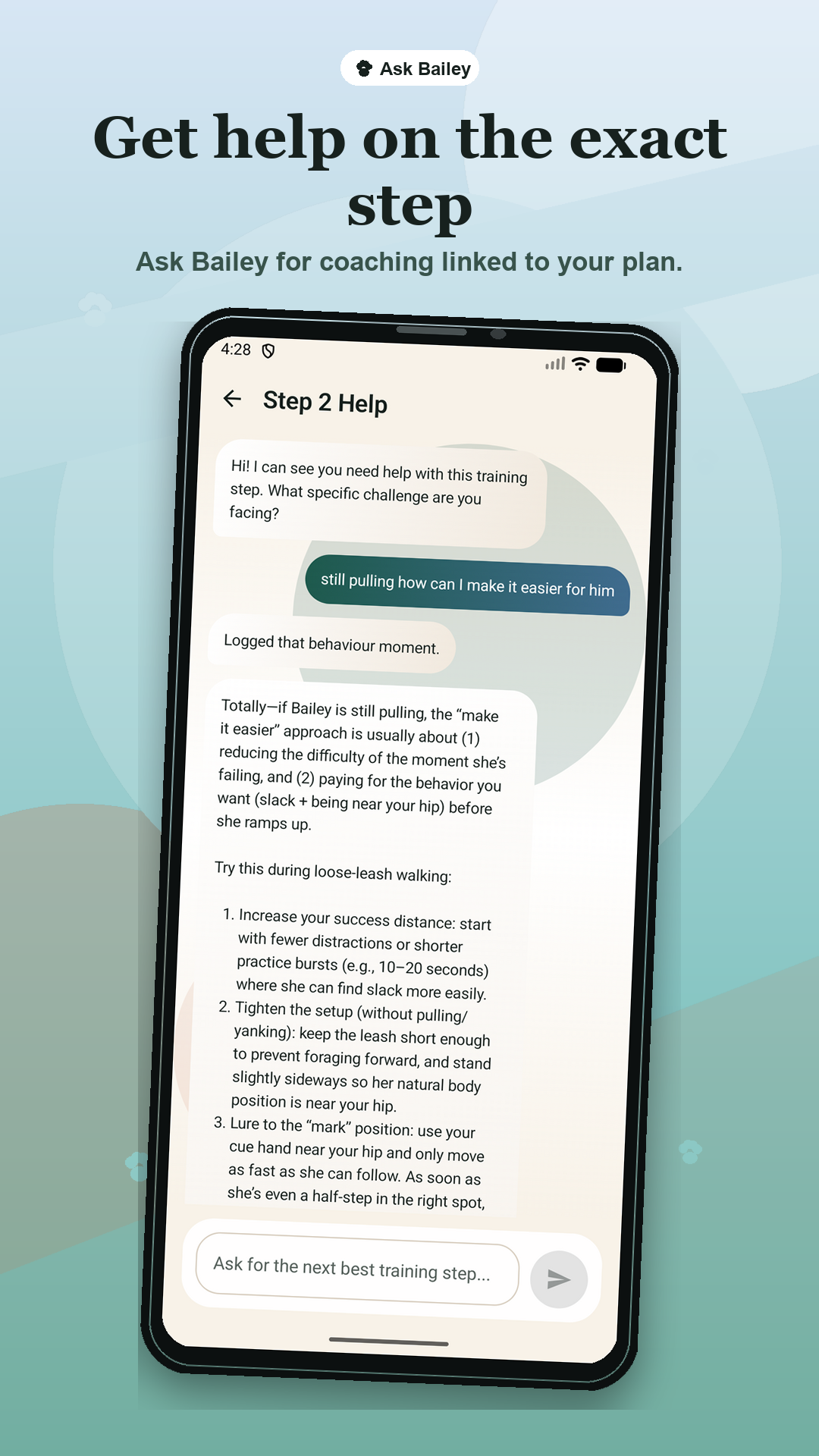
Step 2: Reward Position, Not Just Behavior
Your puppy needs to learn that being beside you (or slightly ahead with a loose leash) is the position that gets rewards. This is where leash positioning becomes crucial.
- Establish your walking position: Decide whether you want your puppy on your left, right, or either side. Consistency helps them learn faster
- Use high-value treats: Small, delicious treats that your puppy can eat quickly. Cheese, chicken, or special training treats work better than kibble
- Reward frequently: At this stage, reward every few steps when the leash is loose. As your puppy improves, gradually increase the distance between rewards
- Keep treats in an easily accessible pocket so you can deliver them instantly when your puppy is in the right position
Step 3: Stop When the Leash Tightens
This is the critical turning point in training. Your puppy learns that pulling doesn't work.
- The moment the leash becomes tight, stop moving completely
- Don't pull back or correct—simply become immovable
- Wait for your puppy to move back toward you or create slack in the leash
- The instant there's slack, say "Yes!" and reward [1]
- Then continue walking
This teaches a powerful lesson: pulling stops forward progress, but a loose leash means forward progress resumes. Eventually, your puppy realizes that staying near you with a loose leash is the way to get where they want to go.
Step 4: Gradually Increase Distractions
Once your puppy masters loose leash walking in your home or yard, slowly introduce more challenging environments:
- Quiet residential streets
- Parks during off-peak hours
- Areas with occasional other dogs or people
- Busier environments (only after mastering quieter ones)
At each new level, go back to rewarding more frequently until your puppy shows consistent loose leash walking, then gradually space out rewards.
Step 5: Let Sniffing Be the Reward
Dogs experience the world primarily through their nose, and a walk without sniffing time is frustrating for them. [1] Once your puppy is walking well on a loose leash, use sniffing as a reward.
- Reward calm walking with permission to sniff interesting spots
- This makes walks more enjoyable for your puppy while reinforcing loose leash behavior
- Consider designating "sniff breaks" where your puppy has freedom to explore within reason
Common Challenges and How to Address Them
"My puppy pulls toward other dogs"
This is one of the most common challenges. Your puppy sees something they want (social interaction) and pulling seems like the way to get it. Change the equation: reward calm walking past other dogs with treats, toys, or eventually, appropriate greetings when the other owner consents. [4]
"The leash is always tight—my puppy never gives me slack to reward"
Start with even shorter training sessions in even quieter environments. Some puppies need to build the habit in ultra-low-distraction settings first. You might also try walking with a longer line (15-20 feet) in a safe, enclosed area so your puppy has more freedom to move around and naturally create slack.
"Training works at home but falls apart on actual walks"
This is normal and doesn't mean your puppy is stubborn—it means you're jumping to harder distractions too quickly. Go back to quieter environments and rebuild. Also ensure you have high-value treats with you on every walk. [1]
"My puppy pulls so hard they cough or seem to struggle breathing"
This requires immediate attention. Switch to a harness immediately and consult your veterinarian. Persistent pulling with breathing difficulties shouldn't continue while you train. [4]
Meeting Your Puppy's Needs Beyond Training
Here's something many owners miss: a puppy who pulls excessively might not have their daily needs met. Before intensifying training, consider: [4]
- Physical exercise: Regular leash walks rarely satisfy a puppy's full exercise needs. Puppies need play, running, and exploration time
- Mental stimulation: Puzzle toys, training sessions, and unstructured exploration engage their brain
- Social interaction: Puppies need to see and interact with other dogs and people in safe, appropriate ways
- Sniffing time: Unstructured exploration and time to follow scents is essential for puppy wellness
A puppy who's getting adequate exercise and mental stimulation is often easier to train because they're not bursting with pent-up energy. Consider adding a long line for unstructured exploration in safe spaces—this isn't training time, just free exploration. [4]
The Role of Handler Behavior
Here's an uncomfortable truth: how you hold and manage the leash affects how much your puppy pulls. [1] Your tension transfers down the leash. If you're nervous, frustrated, or holding the leash tightly, your puppy feels it.
- Hold the leash loosely in a relaxed grip
- Keep your shoulders back and posture open—don't lean forward into pulls
- Stay calm and patient even when frustrated; your puppy reads your emotions
- Avoid repetitive corrections or tugging; this often increases pulling
- Speak in a calm, encouraging tone when rewarding
Building the Bond Through Training
Loose leash walking isn't just about obedience—it's about communication and trust. When your puppy learns that staying near you and checking in with you leads to good things, they're not just learning a behavior; they're learning that you're a reliable, rewarding companion. [1]
Over time, many puppies naturally start checking in with their owners during walks, looking back to confirm they're still together. This is the goal: a puppy who wants to be near you because being near you is where the best things happen.
Timeline and Expectations
How long does this take? It varies. A 12-week-old puppy practicing 5 minutes daily in their yard might show noticeable improvement in 2-3 weeks, though busier environments might take longer. [1] Consistency matters far more than intensity—daily 5-minute sessions beat sporadic 30-minute marathons.
Remember: loose leash walking is genuinely one of the most complex skills puppies learn. [4] Be patient with yourself and your puppy. Celebrate small wins. If your puppy went three steps without pulling when they used to pull every step, that's progress worth celebrating.
When to Seek Professional Help
If your puppy pulls so hard they physically overpower you, shows signs of aggression toward other dogs or people while pulling, or if you're feeling consistently frustrated or unsafe, consult a certified professional dog trainer or veterinary behaviorist. They can assess your specific situation and create a customized training plan. There's no shame in getting expert help—in fact, it often makes the process faster and more enjoyable for everyone.
Your Action Plan: Start Today
You don't need perfect conditions to begin. Here's what to do right now:
- Assess your current equipment: Do you have a properly fitting collar or harness? If not, get one before your next training session
- Gather high-value treats: Find small treats your puppy goes crazy for
- Choose a quiet location: Your home, yard, or a very quiet street
- Schedule 5-minute sessions: Consistency beats intensity
- Commit to one week: Give this approach a full week of daily practice before evaluating progress
Loose leash walking transforms walks from a struggle into quality time with your puppy. The patience you invest now creates years of enjoyable outdoor adventures together. Your puppy is absolutely capable of learning this—and so are you.