Why Your Puppy Needs an Emergency Stop Command
Imagine your puppy spots a squirrel and bolts toward the street. You call their name, but momentum carries them forward into traffic. This terrifying scenario is exactly why an emergency stop command is one of the most important skills you'll ever teach your dog.
An emergency stop differs fundamentally from a standard recall. Where a recall asks your dog to run toward you, an emergency stop freezes them in place—regardless of their direction of movement. This distinction matters because in genuine emergencies, calling your puppy to you might actually increase danger. If they're already running toward a busy road, a recall could send them directly into traffic. An emergency stop halts all forward movement instantly [4].
This command works because it gives you a safety tool that operates at a distance and works whether your puppy is running toward you, away from you, or alongside you. Think of it as the opposite of a recall—equally powerful, equally important [4].
What Makes Emergency Stop Different From Other Commands
Your puppy probably already knows "sit" and "stay." So what's the difference? The key distinction lies in context and execution.
- Distance teaching: You'll teach the emergency stop while your puppy is moving away from you or at a distance, not sitting directly in front of you [2]
- Motion-based: Your puppy learns to freeze from a fast run, not from a stationary position. This requires them to physically collect themselves and stop on a dime—something that's surprisingly difficult [4]
- Directional independence: The command works regardless of which direction your puppy is facing or moving. They don't need to see you to respond [2]
- Dual signals: You'll pair both a hand signal and verbal cue, making the command clear even when your puppy is far away or distracted [2]
What You'll Need to Get Started
The beauty of teaching an emergency stop is its simplicity. You won't need expensive equipment or complicated setups. Here's what works best:
- High-value treats: Use extra-smelly, extra-tasty treats your puppy goes crazy for. Reserve these specifically for this training—don't use them for everyday rewards [2]
- A treat-dispensing tool (optional but recommended): A "clam" or similar treat-dispensing toy works brilliantly because it's visible at distance and you can throw it with accuracy. This is far more effective than loose treats [2]
- A long line (10-15 feet): For safety during early training stages, especially outdoors [5]
- A distraction-free training space: Start indoors or in a quiet yard with minimal environmental stimuli [2]
- Patience and consistency: Plan for several weeks of training. This isn't a command your puppy will master in a day or two [5]
Step-by-Step Training Guide
Stage 1: Build Enthusiasm for Your Training Tool (Week 1)
Before you teach the actual command, your puppy needs to develop genuine excitement about the training tool—whether that's a clam or treat pouch.
- Show and celebrate: Open your clam or treat container and let your puppy see the treats inside. Make it a big deal. Let them eat the treats directly from your hand [2]
- Close the container: Gently close the clam with treats inside. Let your puppy use their nose to figure out how to get the treats out. Use extra-smelly treats if your puppy seems uninterested [2]
- Lure with the tool: Move the clam slowly in front of your puppy's nose. Let them follow it with their eyes and nose. Open it and reward them for following [2]
- Repeat daily: Do this for 3-5 minutes daily until your puppy actively seeks out the clam with obvious enthusiasm [2]
Your goal here is simple: your puppy should see the clam and think "YES! That's the best thing ever!" This motivation becomes your training superpower.
Stage 2: Introduce the Hand Signal (Week 2)
Now you'll teach the physical cue that will eventually become your emergency stop signal.
- Get your puppy's attention: Have your puppy eagerly following the clam as you move it around slowly. Their eyes should be locked on it [2]
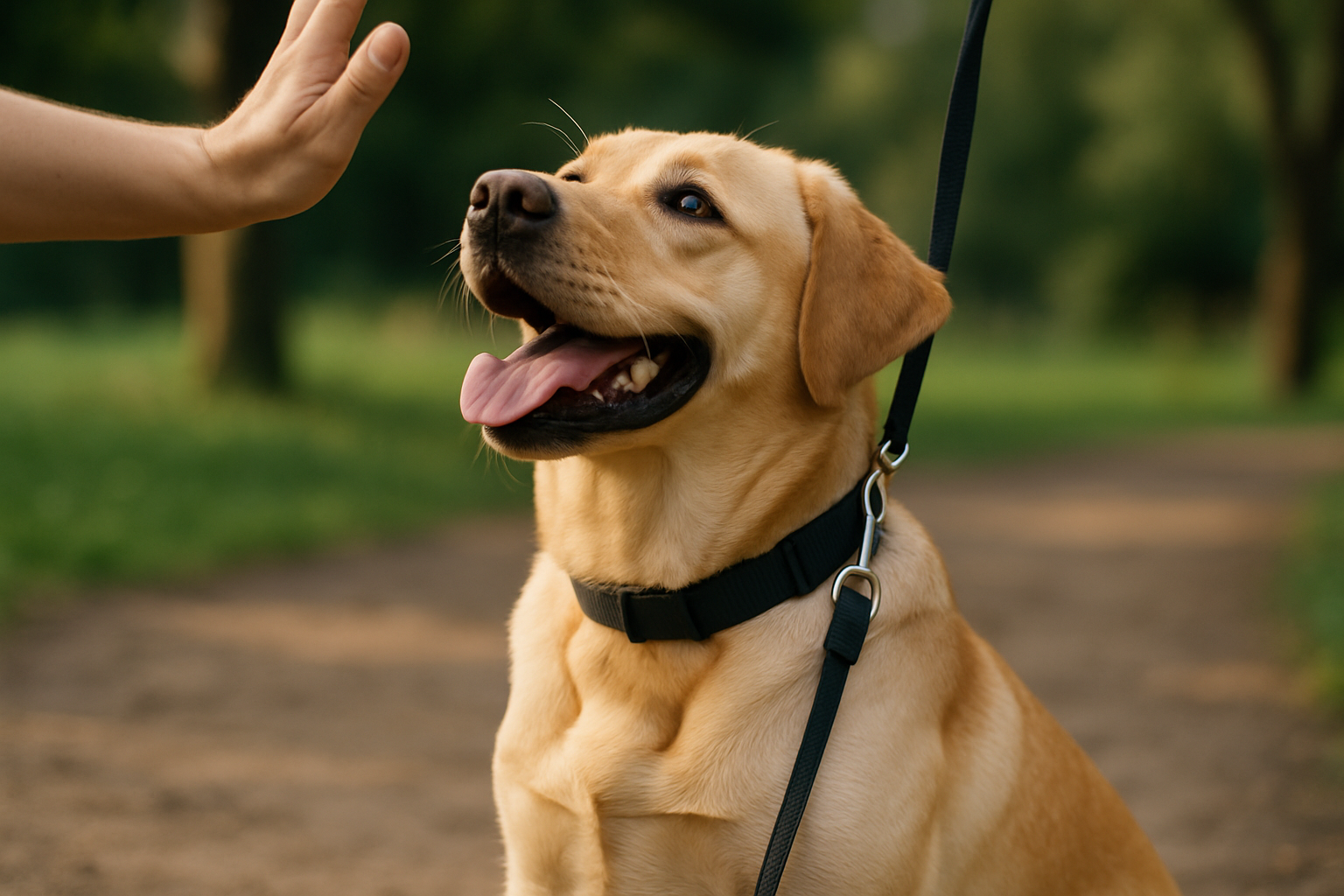
- Execute the signal: Shoot your arm up in the air suddenly. Most puppies will look up at your raised arm and naturally sit as they look up [2]
- Reward immediately: The instant your puppy's bottom touches the ground, drop the clam at their feet. Let them retrieve the treats [2]
- Repeat 5-10 times: Do this several times per session. Your puppy will quickly connect the raised arm with the reward [2]
- Important detail: Reward from behind your puppy's position. This prevents them from creeping forward in anticipation of treats, which builds duration into your command [2]
At this stage, your puppy is learning that the raised arm means "sit, and good things happen." They're not yet stopping from motion, but you're building the foundation.
Stage 3: Add Distance and Direction (Week 3)
This is where the training becomes more realistic. You'll now teach your puppy to respond when they're moving away from you.
- Create distance: Pretend to throw the clam away from you to redirect your puppy's attention. They'll naturally move away [2]
- Deliver the cue: When your puppy is moving away from you, raise your arm and cue "stop" or "freeze" [2]
- Reward the response: When your puppy sits, throw the clam just behind them so they retrieve it from their current position [2]
- Increase distance gradually: Start at 5-10 meters away. Once your puppy reliably responds at this distance, slowly increase it [2]
- Vary the scenario: Practice with your puppy moving in different directions—away, toward, and alongside you [4]
Your puppy is now learning to stop from motion and at a distance. This is the real emergency stop taking shape.
Stage 4: Introduce the Verbal Cue (Week 3-4)
Once your puppy is reliably responding to the hand signal, add a verbal cue. Many trainers use "freeze" or "stop."
- Pair the cues: Say the verbal cue ("freeze") at the exact moment you raise your arm [4]
- Be consistent: Always use the same word and the same hand signal together [2]
- Test both signals: After several repetitions, try the verbal cue alone, then the hand signal alone. Your puppy should respond to either one [2]
- Practice in short bursts: 5-10 repetitions per session is plenty. More than that becomes counterproductive and boring [5]
Stage 5: Transition to Real-World Environments (Week 4-6)
Your puppy has mastered the emergency stop in a quiet space. Now it's time to proof the command in the real world.
- Start low-distraction outdoor spaces: Move training to a quiet park or backyard with minimal distractions [2]
- Use a long line for safety: Keep your puppy on a 10-15 foot long line during this phase. If they don't respond, the line prevents real danger [5]
- Gradually increase difficulty: Add mild distractions first (a person walking nearby), then moderate distractions (other dogs at distance), then higher distractions [2]
- Maintain high-value rewards: In distracting environments, your rewards must be even more compelling than the environment [2]
- Build distance slowly: Increase the distance between you and your puppy as their reliability improves [2]
Common Training Mistakes to Avoid
Even with the best intentions, certain habits can derail your training:
- Training too long: More than 10-15 minutes of focused training per session leads to fatigue and reduced learning. Shorter, more frequent sessions work better [5]
- Inconsistent signals: If you sometimes raise your arm high and sometimes just halfway, or use different verbal cues, your puppy becomes confused. Consistency is everything [2]
- Rewarding the wrong behavior: If your puppy sits but then immediately creeps forward, reward them for the sit from their position—don't let them come to you [5]
- Skipping the foundation: Jumping straight to distance training before your puppy understands the hand signal leads to failure. Build each stage completely before progressing [2]
- Expecting perfection too soon: Allow imperfection to gain perfection. Your puppy doesn't need a perfect sit; they need to freeze their forward motion [5]
- Using the command in emergency situations before it's solid: Only use the emergency stop in real danger once your puppy responds reliably in training. Don't test a half-trained command when your puppy's safety depends on it
Real-World Scenarios Where This Command Saves Lives
Understanding when to use an emergency stop helps you appreciate its value:
- The street crossing: Your puppy spots you across a busy street and bolts toward traffic. "Freeze!" stops them before they step into danger [4]
- The wildlife encounter: Your off-leash puppy notices a deer and takes off. The emergency stop halts the chase before they disappear into the woods [2]
- The dangerous path: During a hike, your puppy spots a frozen pond or cliff edge ahead. The command stops them before they get close [2]
- The approaching hazard: A cyclist is barreling toward your puppy at the dog park. The emergency stop prevents collision [2]
- The chase prevention: Your puppy is chasing another dog or small animal that could lead them into traffic or injury. The stop command interrupts the chase instantly [4]
How Long Does Training Take?
The timeline depends on your puppy's age, temperament, and your training frequency. Most puppies show solid understanding within 4-6 weeks of consistent practice. However, fully proofing the command—so it works reliably in any environment and situation—takes longer [5].
Here's a realistic timeline:
- Weeks 1-2: Building enthusiasm for the training tool and introducing the hand signal
- Weeks 3-4: Adding distance, direction changes, and verbal cues
- Weeks 5-8: Transitioning to real-world environments and increasing difficulty
- Months 3+: Ongoing practice and proofing in increasingly challenging situations
Remember that this is an investment in your puppy's safety. The time spent now could literally save their life later.
Tips for Success
- Practice in short, frequent sessions: Five minutes of focused training five times per week beats one 30-minute session [5]
- Keep training positive: Never punish your puppy for not responding. Instead, make the reward so good they can't resist [2]
- Vary your training locations: Once your puppy understands the command, practice in different places so they learn it's not location-specific [2]
- Use a consistent hand signal: Your raised arm should look the same every time. This clarity helps your puppy understand instantly [2]
- Celebrate success: When your puppy responds correctly, especially in a distracting environment, make it a party. Extra treats, excited praise, the works [2]
- Stay patient with the learning curve: Some puppies grasp this faster than others. Genetics, temperament, and prior learning all play roles. Trust the process [5]
Final Thoughts: A Lifesaving Investment
Teaching your puppy an emergency stop isn't just another training trick to impress friends. It's one of the most practical, potentially life-saving commands you'll ever teach. In a split second, when your puppy is in genuine danger, this command could be the difference between a close call and a tragedy.
The training itself is straightforward, requires minimal equipment, and fits easily into your weekly routine. The benefits—giving your puppy more off-leash freedom, greater safety in unpredictable situations, and peace of mind for you—are immeasurable.
Start today with Stage 1. Build your puppy's enthusiasm for the training tool. Then progress methodically through each stage. Within a few weeks, you'll have a puppy who can freeze in place on command—a skill that could save their life.