Why Positive Reinforcement Works for Puppies
When you bring a new puppy home, you're not just getting an adorable furry friend—you're gaining a responsibility that will shape their entire life. The training methods you choose during these critical early months can determine whether your puppy grows into a confident, obedient companion or develops behavioral challenges that persist into adulthood.
Positive reinforcement has emerged as the gold standard in modern puppy training, and for good reason. Unlike outdated punishment-based methods, this approach is rooted in animal learning science and focuses on rewarding the behaviors you want rather than punishing those you don't. [4] The beauty of this method is that it strengthens desired behaviors while simultaneously building a foundation of trust between you and your puppy.
At its core, positive reinforcement is straightforward: when your puppy performs a desired behavior, you immediately add something they value—whether that's a treat, praise, playtime, or affection. This creates a positive association in your puppy's mind, making them more likely to repeat that behavior in the future. [1] It's not a bribe or a gimmick; it's applied animal psychology that produces measurable, lasting results.
Understanding the Science Behind Positive Reinforcement
To truly master positive reinforcement training, it helps to understand the learning principles at work. Your puppy's brain is constantly making connections between their actions and the consequences that follow. This process, called operant conditioning, means your puppy learns to repeat behaviors that result in pleasant outcomes and avoid those that don't. [4]
Think of it this way: if your puppy sits when you ask and immediately receives a treat, they'll begin to understand that sitting equals rewards. Over time, sitting becomes their default response to your request. However, this only works if the reward is something your puppy genuinely values at that moment. A puppy who just ate a full meal might not find food as motivating as access to outdoor playtime or a favorite toy. [1] Understanding your individual puppy's preferences is crucial to successful training.
The timing of your reward is equally important. Trainers often use a "marker"—typically a clicker or verbal cue like "yes!"—to mark the exact moment your puppy completes the desired behavior. This bridge between the behavior and the reward helps your puppy understand precisely what earned them the reinforcement. [1] Without this clarity, your puppy might become confused about which action earned the reward.
Getting Started: Setting Up Your Puppy for Training Success
Before you begin formal training sessions, create an environment that sets your puppy up for success.
- Keep sessions short and frequent: Puppies have naturally short attention spans. Rather than one 30-minute training session, aim for three to five 5-10 minute sessions throughout the day. This prevents overwhelm and keeps your puppy engaged. [3]
- Choose the right rewards: Identify what genuinely motivates your puppy. Some puppies are treat-driven, while others prefer toys or verbal praise. Many trainers use a portion of your puppy's daily food ration as training rewards, which keeps your puppy motivated while maintaining their overall calorie intake. [5]
- Minimize distractions: Start training in a quiet, familiar space before gradually introducing more challenging environments. This allows your puppy to focus entirely on learning.
- Maintain consistency: Everyone in your household should use the same commands, rewards, and expectations. Inconsistency confuses puppies and slows progress. [3]
Teaching Basic Commands with Positive Reinforcement
The foundation of all puppy training rests on teaching basic commands. These aren't just about obedience—they're about establishing communication and building impulse control. [3]
Teaching "Sit"
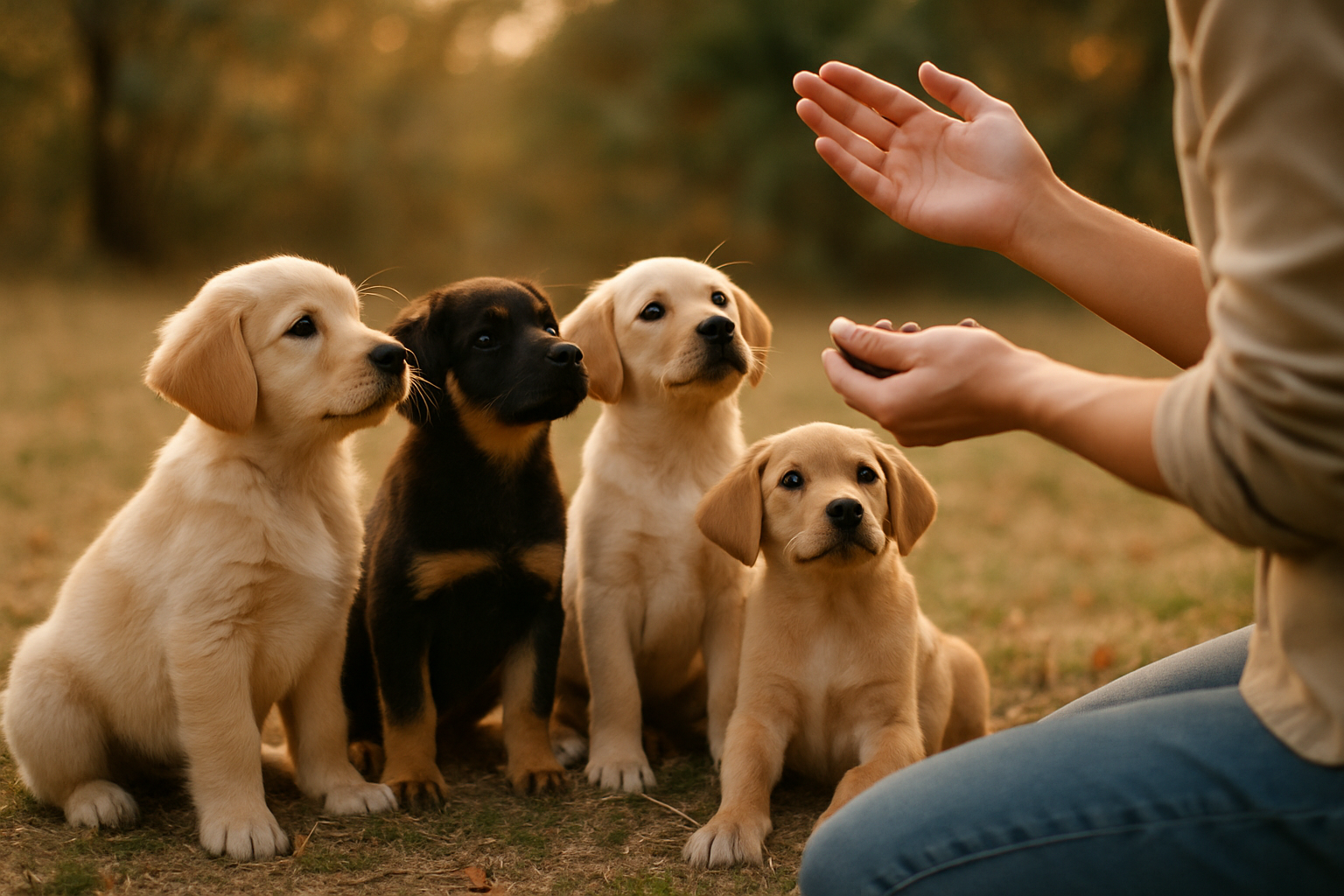
Start with the easiest command: sit. Hold a treat close to your puppy's nose, then slowly move it upward and slightly back over their head. As their nose follows the treat, their bottom naturally lowers to the floor. The moment their rear touches the ground, mark the behavior (click or say "yes!"), then immediately deliver the treat and enthusiastic praise.
Repeat this 5-10 times per session. Within a few days, your puppy will begin anticipating the sit. Once they're reliably sitting, add your verbal cue ("sit") just before luring them into position. Eventually, you'll fade out the lure and rely on the verbal command alone.
Teaching "Come"
This command can be lifesaving, so invest time in making it incredibly rewarding. Start in a confined space where your puppy can't wander far. Get down to their level, show them a treat or toy, and enthusiastically call their name followed by "come!" When they reach you, celebrate wildly with treats, praise, and play. [3] Make coming to you the best thing that could possibly happen.
As your puppy becomes reliable, gradually increase distance and add mild distractions. Always ensure that coming to you is more rewarding than whatever else they might be doing.
Teaching "Stay"
This command requires impulse control, so introduce it only after your puppy has mastered sit and come. Ask your puppy to sit, then hold your hand up in a stop gesture and say "stay." Wait just one second, then mark, reward, and praise. Gradually increase the duration and distance over many training sessions. [3] Never set your puppy up for failure by asking them to stay too long too soon.
Housebreaking with Positive Reinforcement
Housebreaking is often a puppy parent's biggest concern, and positive reinforcement makes this process significantly smoother. The key is consistency and vigilance combined with strategic rewards.
- Establish a routine: Take your puppy outside first thing in the morning, after meals, after naps, after playtime, and before bedtime. Puppies have small bladders and need frequent opportunities to eliminate. [3]
- Choose a designated potty spot: Always take your puppy to the same area. The familiar scent encourages them to eliminate there.
- Reward immediately: The moment your puppy finishes eliminating outside, deliver treats and enthusiastic praise. This creates a powerful association between outdoor elimination and positive outcomes. [1]
- Supervise indoors: Watch for signs your puppy needs to go (sniffing, circling, whining). If you catch them in the act indoors, calmly interrupt and take them outside to finish. Never punish accidents—this creates fear and confusion.
- Use crate training: Dogs naturally avoid soiling their sleeping area, so a properly-sized crate becomes a powerful housebreaking tool when combined with frequent outdoor breaks. [5]
Building a Strong Bond Through Training
Beyond teaching specific behaviors, positive reinforcement training strengthens the relationship between you and your puppy. When your puppy learns that you're the source of good things—treats, praise, play, and safety—they naturally gravitate toward you and become more responsive to your guidance.
This bond is invaluable. A puppy who trusts you is more likely to check in with you during walks, respond to your commands even when distracted, and feel secure enough to explore the world confidently. [1] Training becomes a conversation rather than a command, and your puppy becomes a willing participant in their own education.
Socialization: Training Your Puppy to Navigate the World
Socialization is training in its broadest sense. It involves exposing your puppy to different people, animals, environments, sounds, and experiences while using positive reinforcement to build confidence and appropriate behavior. [5]
During their critical socialization window (typically 3-14 weeks), puppies are naturally curious and less fearful. This is the ideal time to introduce them to the world they'll navigate as adults. Pair new experiences with treats, praise, and play to create positive associations.
Properly socialized puppies are less likely to develop fear-based aggression or anxiety later in life. They grow into confident adults who can handle novel situations with composure. [3]
Managing Common Puppy Behaviors
Puppies naturally explore the world with their mouths, leading to biting and chewing behaviors. Rather than punishing these instincts, redirect them using positive reinforcement.
Addressing Biting and Nipping
During play, puppies sometimes bite too hard. Mimic how other puppies respond: make a high-pitched yelp and pause play briefly. This communicates that the bite was too rough. Then redirect their attention to an appropriate toy and reward calm play. [3] Consistency teaches your puppy the boundaries of acceptable play without creating fear.
Managing Chewing
Provide appropriate chew toys and redirect your puppy's chewing toward these items. When your puppy chooses to chew their toy instead of your furniture, reward them enthusiastically. During teething, offer frozen toys or appropriate chew treats to soothe their gums. [3]
Common Mistakes to Avoid
Understanding what doesn't work is as important as knowing what does.
- Inconsistent reward timing: If you don't reward immediately after the behavior, your puppy won't make the connection. Delayed rewards are ineffective.
- Wrong reward choice: A reward that doesn't motivate your puppy isn't a reward. Pay attention to what your individual puppy values.
- Expecting instant results: Behavior change takes time and repetition. If your puppy isn't improving, examine your execution rather than assuming positive reinforcement doesn't work. [1]
- Mixing methods: Combining positive reinforcement with punishment creates confusion and undermines trust. Commit to one approach.
- Training when frustrated: Your puppy picks up on your emotional state. End sessions on a positive note and never train when you're angry.
The Long-Term Benefits of Starting Right
The investment you make in positive reinforcement training during puppyhood pays dividends throughout your dog's life. Puppies trained this way develop into adults who are eager to learn, responsive to commands, and confident in their relationship with you. [1] They're less likely to develop behavioral problems stemming from fear or anxiety, and they maintain their enthusiasm for training well into adulthood.
Moreover, positive reinforcement builds a foundation of trust that makes veterinary visits, grooming, and other necessary handling easier and less stressful for your dog. Your puppy learns that cooperating with you leads to positive outcomes, making them a joy to live with.
Creating Your Training Plan
Start your positive reinforcement journey with a clear plan:
- Identify 2-3 basic commands to teach first (sit, come, stay)
- Determine your puppy's primary motivators (treats, toys, praise)
- Set a training schedule: 3-5 short sessions daily
- Establish consistency across your household
- Track progress to stay motivated
- Gradually increase difficulty and distractions
- Consider puppy training classes for professional guidance and socialization
Final Thoughts
Raising a puppy is one of life's great privileges, and how you train them during these formative months matters enormously. Positive reinforcement training isn't just about teaching commands—it's about building a relationship based on trust, communication, and mutual respect. [1]
Your puppy is eager to learn and wants to please you. By using positive reinforcement, you're tapping into their natural desire to work with you rather than against you. You're creating a confident, well-adjusted dog who sees you as their trusted leader and cherished companion. The time and patience you invest now will reward you with years of joy, obedience, and unconditional love.
Sources & References
- https://www.petmd.com/dog/behavior/how-to-train-a-dog-with-positive-reinforcement
- https://www.upstatecanine.com/blog/how-to-train-a-puppy/
- https://www.akc.org/expert-advice/training/operant-conditioning-positive-reinforcement-dog-training/
- https://www.thepuppyacademy.com/blog/tag/positive+reinforcement+puppy+training