Introduction: Why Every Puppy Parent Needs First Aid Knowledge
Puppies are bundles of boundless energy and curiosity. They explore the world with their mouths, chase anything that moves, and seem determined to find every potential hazard. While this adventurous spirit is part of what makes puppies so endearing, it also means accidents happen—sometimes when you least expect them. [1]
Unlike human emergencies where you can call 911, there's no emergency hotline for dogs. Your quick thinking and knowledge could be the difference between a minor incident and a life-threatening situation. Being prepared isn't about being paranoid; it's about being a responsible, caring pet parent who can act confidently when seconds count. [3]
The good news? Puppy first aid isn't complicated. You don't need to be a veterinarian to learn the basics. With the right knowledge and preparation, you can stabilize your puppy, manage their pain, and get them to professional care safely.
Building Your Puppy First Aid Kit: Essential Items You Need
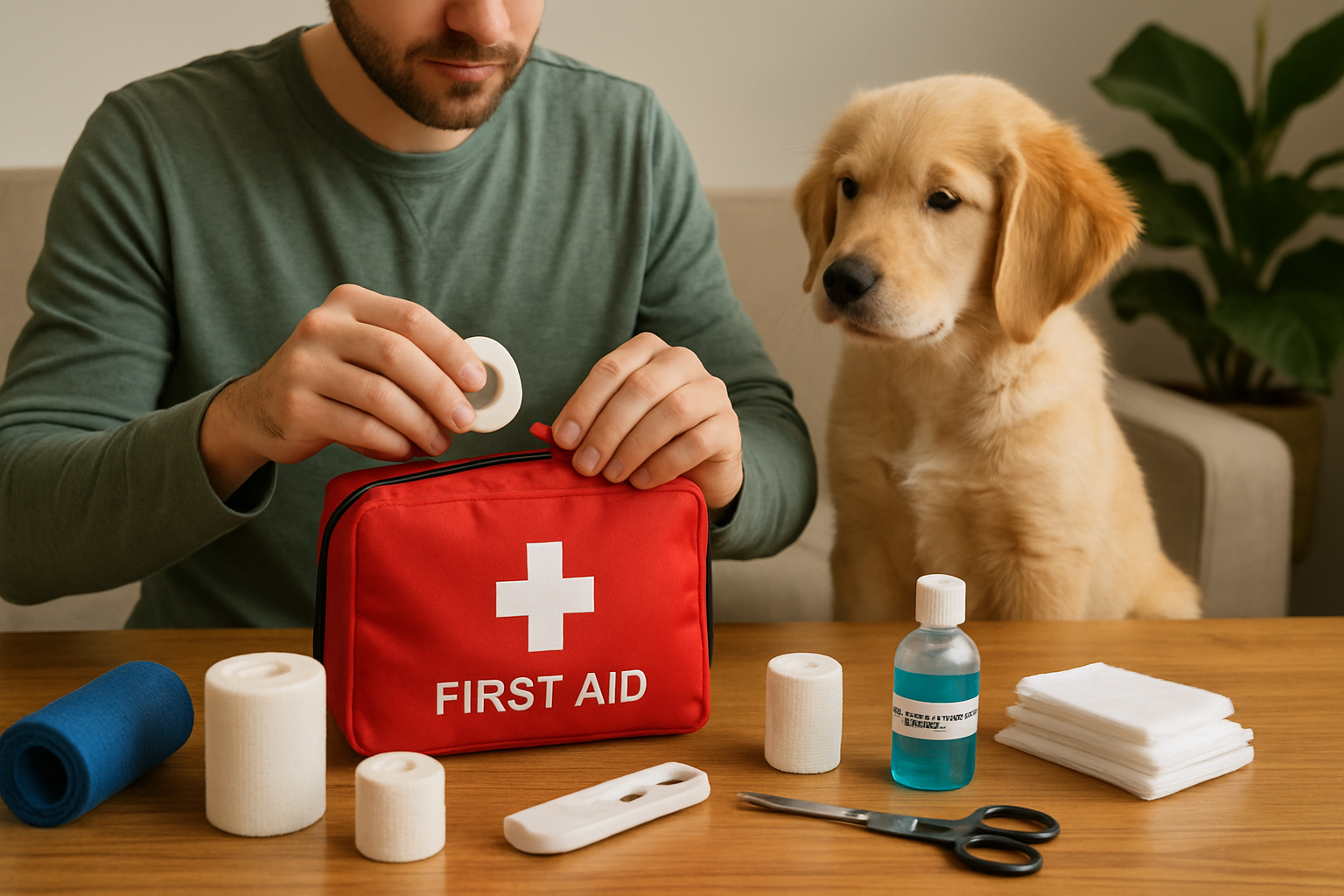
An organized, accessible first aid kit is your most important tool for handling emergencies. Rather than scrambling to find supplies when panic sets in, having everything in one place allows you to act immediately and confidently. [4]
Here's what your puppy first aid kit should contain:
- Contact Information: Your veterinarian's number, emergency vet clinic address and phone, and poison control hotlines (ASPCA at 888-426-4435 or Pet Poison Helpline at 855-764-7661) [4]
- Wound Care Supplies: Sterile gauze pads (including non-stick varieties), gauze rolls, bandaging tape designed for pets, and antiseptic solutions like chlorhexidine 2% or povidone iodine (diluted appropriately) [4]
- Safety Equipment: A basket muzzle or materials to create a temporary muzzle from gauze or cloth, an Elizabethan collar, and a pet thermometer with lubricant [4]
- Medications: Styptic or blood clotting powder for torn nails, hydrogen peroxide 3% solution (only for inducing vomiting if your vet instructs), and vet-approved medications like antihistamines [4]
- Transportation Aids: A sturdy carrier for small puppies, a thick blanket that can serve as a makeshift stretcher, or a strong board for larger breeds [4]
- Additional Items: Tweezers for splinter removal, saline solution, clean towels, and printed instructions for common emergencies with pictures [4]
Store your kit in an easily accessible location that everyone in your household knows about. Review its contents quarterly to replace expired items and ensure everything is still in good condition. [5]
Staying Calm: Your Most Important First Aid Tool
Before we discuss specific techniques, understand this fundamental truth: your emotional state directly affects your puppy's response. When you panic, your puppy panics. When you remain calm, you give your puppy the best chance at recovery. [1]
In an emergency:
- Take several deep breaths before approaching your injured puppy
- Move slowly and speak in soothing, reassuring tones
- Remember that injured puppies may act unpredictably—even normally friendly puppies might bite when frightened and in pain [1]
- Never put yourself in danger. You can't help your puppy if you're injured
- Call your veterinarian immediately for guidance—they can direct you on whether to administer first aid or go straight to the emergency clinic [4]
Managing Common Puppy Injuries: Step-by-Step Guidance
Cuts, Scrapes, and Minor Bleeding
Cuts and scrapes are among the most common puppy injuries. The key is determining whether you're dealing with a minor wound or something requiring immediate veterinary attention. [1]
For minor cuts:
- Gently clean the wound with saline solution or clean water [5]
- Apply light pressure with a clean cloth to stop bleeding
- Use an appropriate antiseptic solution (chlorhexidine or diluted povidone iodine) to disinfect—avoid hydrogen peroxide or alcohol, as these can damage healthy tissue and delay healing [4]
- Apply gauze and secure with pet-safe bandaging tape
- Monitor the wound daily for signs of infection
For serious bleeding:
- Apply firm, continuous pressure with a clean cloth for 3-5 minutes [3]
- Check if bleeding has stopped after this time
- If bleeding continues, apply pressure for another 3 minutes before checking again [3]
- Seek emergency veterinary care immediately if bleeding won't stop after 5-10 minutes of pressure [4]
- Do not remove the initial cloth if it becomes stuck—this could restart bleeding. Instead, add additional gauze on top
Deep lacerations, puncture wounds, or any wound that won't stop bleeding requires professional veterinary attention. [1]
Suspected Broken Bones or Fractures
Broken bones are serious injuries that demand immediate professional care. Your role is to prevent further damage during transport. [1]
If you suspect a broken bone:
- Keep your puppy as calm and immobile as possible—movement can cause additional injury [3]
- Place them on a flat, firm surface you can transport easily, such as a travel crate or makeshift stretcher [3]
- Secure them gently with a towel or blanket to prevent movement without restricting breathing [3]
- Keep them warm unless heat stroke is suspected
- Transport immediately to an emergency veterinary clinic
- Avoid manipulating or examining the suspected fracture, as this can cause additional pain and injury
Signs of a broken bone include limping, crying or whimpering, holding a limb up, reluctance to move, or visible deformity. [1]
Choking Emergencies
Puppies investigate their world with their mouths, making choking a genuine risk. Recognizing and responding quickly to choking can save your puppy's life. [1]
Signs your puppy is choking:
- Difficulty breathing, gasping, or struggling for air
- Pawing at their mouth
- Coughing or gagging sounds
- Panic or distress
- Blue-tinted gums or tongue (indicates severe oxygen deprivation) [1]
What to do:
- Carefully open your puppy's mouth and look for visible obstructions—but don't push deeper into the throat [5]
- If you can see the object and safely reach it, remove it gently
- For larger puppies, try a modified Heimlich maneuver: place your hands just behind their ribcage and apply firm, quick pressure [5]
- For smaller puppies, this technique may be less effective, so focus on gentle removal of visible objects
- Seek emergency veterinary care immediately, even if you successfully removed the object—internal damage may have occurred [1]
Poisoning and Toxic Ingestion
Puppies eat things they shouldn't. Chocolate, certain plants, medications, household chemicals, and foods toxic to dogs are common household hazards. [5]
If you suspect poisoning:
- Stay calm—panic won't help your puppy
- Call your veterinarian or poison control immediately (ASPCA: 888-426-4435 or Pet Poison Helpline: 855-764-7661) [4]
- Have the following information ready: what your puppy ate, approximately how much, and when it was ingested
- Do NOT induce vomiting unless specifically instructed by your vet—vomiting can sometimes cause more harm than the original ingestion [5]
- Follow your vet's specific instructions, which may include bringing in the product packaging or a sample
Heatstroke
Puppies are vulnerable to heatstroke, especially during warm months or after exercise. Unlike other injuries, heatstroke requires cooling rather than warming. [1]
Signs of heatstroke:
- Excessive panting
- Heavy drooling
- Weakness or collapse
- Glazed eyes
- Vomiting or diarrhea
- Rapid heart rate
Emergency response:
- Move your puppy to a cool area immediately
- Apply cool (not cold) water to their body, especially their paws and ears [5]
- Offer small amounts of cool water to drink if they're conscious
- Contact your veterinarian immediately—heatstroke can cause organ damage even after cooling [5]
- Continue cooling efforts during transport to the vet
Recognizing Shock and Loss of Consciousness
Shock occurs when your puppy's body isn't receiving adequate blood flow. This is a life-threatening emergency requiring immediate action. [1]
Signs of shock:
- Pale or white gums
- Weak or rapid pulse
- Shallow, rapid breathing
- Weakness or collapse
- Cold extremities
- Unresponsiveness
If your puppy is unconscious or in shock:
- Place them in the recovery position: on their side with their head tilted back and tongue moved forward to clear the airway [3]
- Check for a heartbeat by placing your fingers on either side of their ribcage between the front legs and applying gentle pressure [1]
- Keep them warm with blankets (unless heat stroke is suspected)
- Call your veterinarian immediately
- Transport to emergency care without delay
Puppy CPR: A Life-Saving Technique
While professional CPR training is invaluable, understanding the basics can help in critical situations. Puppy CPR follows the same A-B-C principle as human CPR: Airways, Breathing, and Circulation. [3]
Before starting CPR:
- Ensure the airway is clear of obstructions
- Place your puppy on a firm surface
- Tilt their head back and move their tongue forward
Rescue breathing:
- For larger puppies: hold their jaw closed and breathe into their nose, watching their chest rise. Give two breaths. [3]
- For smaller puppies: cover their nose and mouth with your mouth and breathe gently, watching their chest rise. Give two breaths. [3]
Chest compressions (varies by size):
- Puppies under 10 pounds: perform "Taco CPR" by cradling them in one arm and using your index and middle fingers on their chest between front legs to compress. Perform 120 compressions per minute. [3]
- Puppies 10-60 pounds: place on their side and perform compressions on the ribcage at 80-100 compressions per minute. [3]
- Puppies over 60 pounds: place on their back and perform compressions like human CPR at 60 compressions per minute. [3]
CPR rhythm: Alternate 30 compressions with 2 rescue breaths. Continue until your puppy responds, begins breathing, or you reach emergency veterinary care. [3]
Important note: Professional CPR certification training is highly recommended. Many organizations, including the Red Cross, offer pet CPR courses both in-person and online. [3]
Handling an Injured Puppy Safely
Even the sweetest puppy may bite when frightened and in pain. Protecting yourself while helping your puppy is essential. [1]
Safety precautions:
- Approach slowly and speak in calm, soothing tones
- Be especially cautious with unfamiliar dogs, as their vaccination status and temperament are unknown [4]
- Consider using a makeshift muzzle if your puppy seems likely to bite—wrap a clean cloth, scarf, or gauze around their muzzle loosely enough that they can still breathe [1]
- A basket muzzle is preferable if available, as it allows panting and breathing through the mouth [4]
- Move only as much as necessary, especially if you suspect broken bones or internal injuries
- Use a carrier, blanket stretcher, or board to transport your puppy safely without causing additional injury
When to Seek Emergency Veterinary Care
Not every puppy problem requires emergency care, but some definitely do. Here's how to decide: [4]
Seek emergency veterinary care immediately for:
- Being hit by a car or other trauma
- Difficulty breathing or gasping for air
- Suspected broken bones or severe injuries
- Excessive bleeding that won't stop after 5-10 minutes of pressure [4]
- Penetrating wounds to the chest or abdomen [4]
- Loss of consciousness or unresponsiveness
- Severe choking or inability to swallow
- Signs of shock (pale gums, weakness, rapid breathing)
- Suspected poisoning or toxic ingestion
- Severe heatstroke symptoms
- Inability to urinate or defecate
- Severe vomiting or diarrhea, especially with blood
- Seizures
Call your veterinarian for guidance if:
- Your puppy is limping, crying, or seems to be in pain
- They're being unusually needy or clingy
- They're licking an area intensely
- Minor cuts or scrapes that you've cleaned
- You're uncertain whether the situation is serious
Remember: it's always better to err on the side of caution. Your vet would rather evaluate a false alarm than miss a serious condition. The peace of mind is invaluable. [1]
Professional Training: The Gold Standard
While this guide provides essential knowledge, nothing replaces hands-on professional training. Consider enrolling in a certified pet first aid and CPR course in your area. [1]
Benefits of professional training:
- Hands-on practice with proper techniques
- Confidence in handling emergency situations
- Immediate access to certified instructors for questions
- Current information on best practices
- Certification that may be required by certain facilities or situations
Ask your veterinarian for course recommendations in your area, or search for Red Cross certified courses online. [3]
Building Your Emergency Preparedness Plan
True preparedness goes beyond having a first aid kit. Create a comprehensive emergency plan:
- Know your resources: Keep your vet's number, emergency clinic address and phone, and poison control numbers easily accessible (written and in your phone)
- Plan transportation: Ensure you have a way to safely transport your puppy to the vet (carrier, blanket, board)
- Share knowledge: Make sure everyone in your household knows basic first aid and where the first aid kit is located
- Practice scenarios: Think through common emergencies and how you'd respond
- Update regularly: Review your plan and kit contents quarterly
- Get trained: Pursue professional certification in pet first aid and CPR
Final Thoughts: Preparation is an Act of Love
Learning puppy first aid isn't about being anxious or overprotective—it's about being prepared and responsible. Accidents will happen; that's part of bringing an energetic puppy into your life. But with the right knowledge, tools, and training, you can respond confidently and potentially save your puppy's life. [3]
Start today by assembling your first aid kit, learning the basics covered in this guide, and committing to professional training. Your puppy depends on you to be their advocate and protector. By taking these steps, you're giving yourself and your puppy the best possible chance at a long, healthy, and happy life together.
Sources & References
- https://zigzag.dog/en-us/blog/puppy-health/new-puppy-health/essential-first-aid-tips-for-new-dog-parents/
- https://www.thepuppyacademy.com/blog/2020/4/13/puppy-first-aid-what-every-puppy-owner-should-know
- https://bondvet.com/blog/first-aid-for-dogs
- https://www.bowmanvet.com/blog/pet-first-aid-tips-for-pet-owners/