Why Mental Stimulation Matters for Growing Puppies
When you bring a puppy home, you're not just welcoming a furry friend—you're bringing home a rapidly developing mind that's hungry for engagement and challenge. Puppies grow at an astonishing pace, both physically and mentally, and their early experiences shape who they'll become as adult dogs. While many owners focus on physical exercise like walks and playtime, the cognitive dimension of puppy development is equally critical. [1]
Without adequate mental engagement, puppies can develop frustration and anxiety that manifest as destructive behaviors—chewing furniture, excessive barking, digging, and aggression. These issues often aren't signs of a "bad" puppy; they're signals of an understimulated mind seeking an outlet for its natural problem-solving drive. [4] The good news? Mental exercises can actually tire puppies out more effectively than physical activity alone, leading to calmer, more relaxed companions at home.
Think of your puppy's brain as a muscle that grows stronger with use. Every puzzle solved, every scent tracked, and every new challenge overcome builds neural pathways that support learning, memory, and emotional resilience throughout their life. [5]
The Science Behind Puppy Brain Development
Understanding how puppies learn helps you design better enrichment activities. Puppies are natural problem-solvers with brains wired to explore, investigate, and figure things out. This instinct served their ancestors well in the wild, and it remains a fundamental part of their psychology today. [2]
When puppies engage in mental challenges, their brains release dopamine—the "happy" chemical that reinforces learning and creates positive associations with the activity. This neurological reward system is powerful: puppies literally feel good when they solve puzzles or discover hidden treats, making them eager to repeat the experience. [4]
Early mental enrichment also builds confidence. Puppies who successfully navigate challenges, even small ones, develop a sense of competence and resilience. This confidence translates into better behavior during training, improved socialization, and a more adaptable adult dog who handles new situations calmly. [1]
Key Benefits of Mental Stimulation for Puppies
Beyond preventing boredom, mental stimulation offers transformative benefits for your puppy's development:
- Enhanced Problem-Solving Skills: Puzzles and interactive toys teach puppies to think through challenges systematically, building cognitive flexibility they'll use throughout their lives. [1]
- Improved Behavior: Puppies with enriched routines are significantly less likely to develop destructive habits, as their mental energy finds positive outlets. [5]
- Faster Learning: Mentally engaged puppies pick up new commands and tricks more quickly, making training sessions more productive and enjoyable for both puppy and owner. [5]
- Reduced Anxiety: Mental challenges provide comfort and a sense of control, helping nervous puppies feel more secure in their environment. [5]
- Better Sleep Quality: A mentally tired puppy is a well-rested puppy. Mental exercise promotes deeper, more restorative sleep, which is crucial for developing brains. [5]
- Stronger Bond: Interactive enrichment activities create shared experiences between you and your puppy, strengthening your relationship through positive engagement. [1]
- Long-Term Cognitive Health: Early mental enrichment supports cognitive function throughout your dog's life, potentially slowing age-related decline. [2]
Beginner-Level Mental Stimulation Activities
Start your puppy's brain training journey with simple, confidence-building activities. These foundational games introduce the concept of problem-solving without overwhelming your young learner.
Hide and Seek
This timeless game is perfect for puppies and requires nothing but your enthusiasm. Ask your puppy to "stay" (or have a helper keep them in another room), hide in an adjacent room or behind furniture, then call your puppy to find you. Start with obvious hiding spots where your scent is easy to detect, then gradually increase difficulty. This activity exercises your puppy's critical thinking and sense of smell while reinforcing recall training. [4]
Find It Games
Begin by placing your puppy in a separate room or crate. While they're confined, hide treats or toys around your home—start with obvious locations like the middle of the floor. Release your puppy, let them sniff your hand to catch the scent, then enthusiastically say "find it!" As they understand the game, hide items in increasingly challenging spots: under cushions, behind doors, in boxes. This game taps into your puppy's natural foraging instincts and builds confidence through successful "hunting." [4]
Puzzle Feeders and Treat-Dispensing Toys
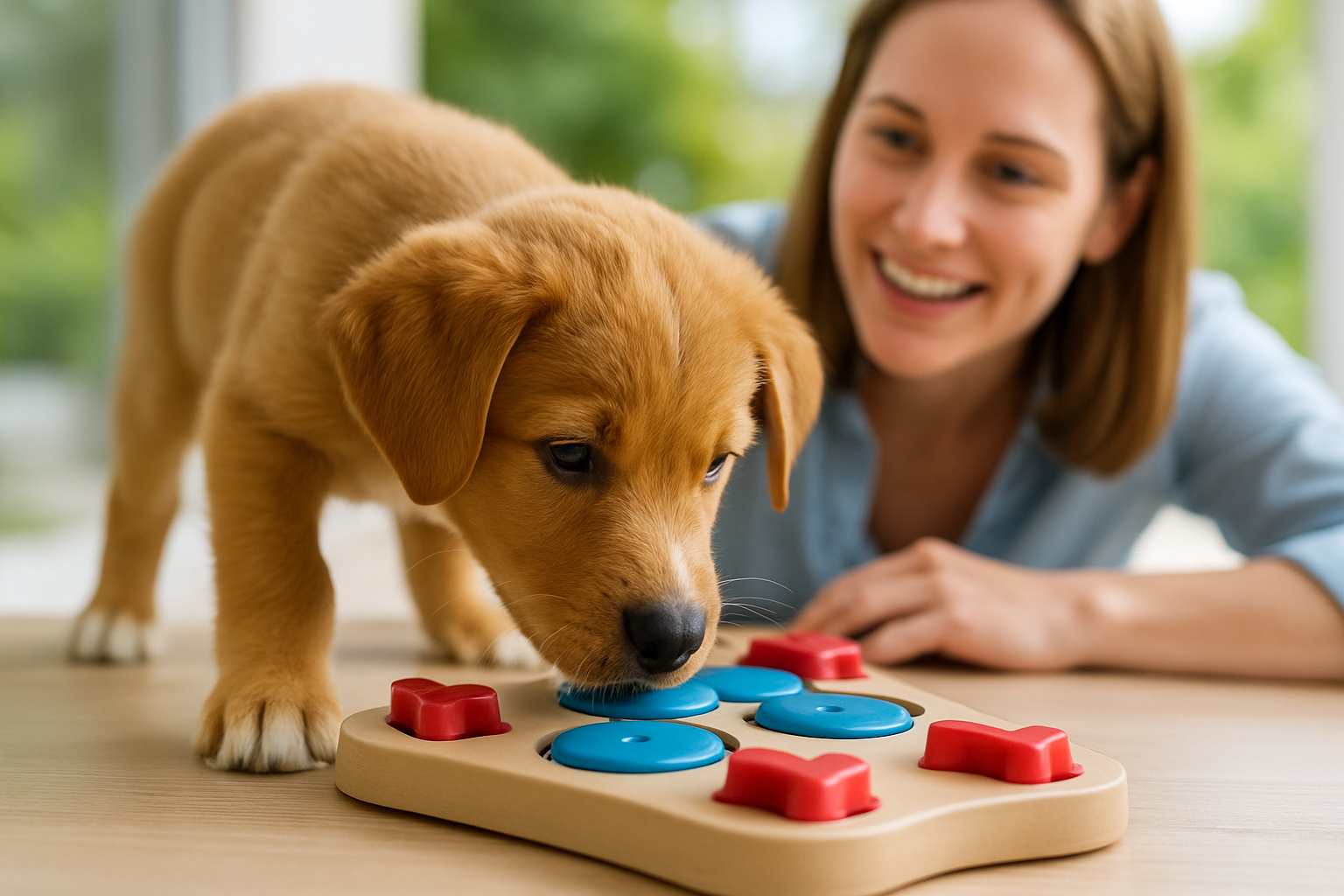
Transform mealtime into an enrichment opportunity with puzzle feeders designed for puppies. These toys have compartments where food or treats hide, requiring your puppy to manipulate the toy to access the reward. Start with beginner-level puzzles that offer moderate challenge without frustration. As your puppy masters each level, advance to more complex designs. This activity slows down fast eaters, prevents bloating, and provides extended mental engagement. [4]
Sniff Walks
Dedicate specific walks to pure sniffing exploration rather than distance or speed. Allow your puppy to linger at interesting spots, explore different textures, and follow scent trails at their own pace. Sniffing isn't just fun—it actively decreases your puppy's stress levels by lowering heart rate and releasing dopamine. These walks are ideal in parks with varied terrain, grass, bushes, and trees. [4]
Scatter Feeding
Take portions of your puppy's regular kibble and hide them in small piles throughout your home or yard. Release your puppy and let them hunt down their meal. This mimics natural foraging behavior, provides nose-work stimulation, and makes eating an adventure rather than a routine. Scatter feeding works especially well for puppies who eat too quickly or seem disinterested in regular mealtimes. [4]
Intermediate Mental Challenges for Growing Puppies
Once your puppy masters beginner activities, introduce more complex games that build on their growing skills and confidence.
Sequential Puzzle Solving
Combine two or more puzzle toys in a chain, where solving one puzzle grants access to the next. This teaches your puppy sequential thinking and persistence—they learn that completing one task opens new opportunities. Start with just two puzzles, then gradually increase the chain as their problem-solving confidence grows. [2]
Toy Name Recognition
Teach your puppy the names of specific toys ("ball," "rope," "duck"), then ask them to retrieve the named item from a collection. This builds vocabulary, strengthens focus, and provides excellent mental exercise. Start with just two toys with distinctly different names, then expand the collection as your puppy's learning accelerates. [2]
Box Search Games
Hide a treat or favorite toy in one of several boxes and encourage your puppy to sniff them out. Start with just two boxes, then increase the number and add distracting scents to make the game more challenging. This develops your puppy's discrimination skills and nose-work abilities. [2]
Mini Obstacle Courses
Create simple courses using household items—cushions to step over, blankets to crawl under, boxes to navigate around. Guide your puppy through the course with treats and encouragement, letting them build confidence while engaging their problem-solving mind. This combines physical and mental stimulation while teaching your puppy to think through spatial challenges. [2]
Scent Work Variations
Advance from simple treat hiding to more sophisticated scent games. Hide a favorite toy under a blanket, inside a partially opened box, or behind furniture. Encourage your puppy to use both their nose and problem-solving skills to locate and retrieve the item. These games develop your puppy's natural scenting abilities while building confidence in their own capabilities. [2]
Advanced Mental Stimulation for Accomplished Puppies
As your puppy matures and masters intermediate challenges, offer advanced enrichment that truly stretches their cognitive abilities.
Multi-Step Puzzle Chains
Link multiple puzzle feeders or interactive toys where each step must be completed to access the next challenge. This builds patience, strategic thinking, and persistence—your puppy learns that sustained effort leads to rewards. These extended puzzle sequences can keep advanced puppies engaged for extended periods. [2]
Choice-Based Games
Teach your puppy to choose between two options—which hand holds the treat, which cup covers the toy, which box contains the reward. Vary the rules to keep your puppy engaged and thinking. This develops decision-making skills and keeps your puppy mentally sharp. [2]
Command Sequencing
Teach your puppy a series of commands (sit, down, spin, bow) and reward them for executing the sequence in order. Gradually increase the number of steps and vary the order. This advanced mental exercise strengthens memory, improves focus, and reinforces obedience training. [2]
Creating a Mental Stimulation Routine
Consistency transforms mental enrichment from occasional fun into a powerful development tool. Here's how to build mental stimulation into your puppy's daily life:
Establish Dedicated Brain Time
Set aside specific times each day for mental activities, just as you would for walks or meals. Even 10-15 minutes of focused brain work can significantly impact your puppy's development. Puppies thrive on routine, and knowing they have "puzzle time" or "game time" builds anticipation and excitement. [5]
Match Challenge to Skill Level
Choose activities that are stimulating without being frustrating. Your puppy should succeed most of the time (roughly 80% success rate), with occasional challenges that require effort. If your puppy consistently fails at a task, it's too difficult; if they solve it instantly, it's too easy. Adjust accordingly. [5]
Rotate Activities Regularly
A toy your puppy hasn't seen in a week feels brand-new and exciting. Rotate between different puzzles, games, and enrichment activities to maintain novelty and prevent boredom. This doesn't require constant new purchases—simply cycling through existing toys keeps engagement high. [5]
Celebrate Success Enthusiastically
Use praise, treats, and playtime as rewards when your puppy completes a task or solves a puzzle. Positive reinforcement makes mental exercises something your puppy genuinely loves and eagerly anticipates. Your enthusiasm is contagious—when you celebrate their success, they're more motivated to tackle future challenges. [5]
Vary Your Environment
Don't limit enrichment to your home. Change your walking routes regularly to expose your puppy to new sights, sounds, and smells. Vary the locations where you hide treats or play games. Environmental novelty is inherently stimulating and prevents your puppy from becoming bored with familiar spaces. [4]
Recognizing Signs Your Puppy Needs More Mental Stimulation
Watch for these behavioral signals that your puppy isn't getting adequate mental engagement:
- Excessive barking or whining, especially when alone
- Destructive chewing of furniture, shoes, or household items
- Digging or scratching at floors or furniture
- Restlessness and inability to settle down
- Hyperactivity that physical exercise alone doesn't resolve
- Inappropriate jumping or mouthing
- Loss of interest in toys or play
- Anxiety or fearfulness in new situations
If you notice these behaviors, increase your mental enrichment activities before assuming your puppy has a behavioral problem. Often, these issues resolve simply through consistent cognitive engagement. [4]
Mental Stimulation and Socialization: A Powerful Combination
Mental enrichment works best when combined with positive socialization experiences. Puppies who engage in structured enrichment activities alongside gentle group play develop into more confident, adaptable adults. [1] Consider puppy playgroups, training classes, or daycare programs that incorporate both mental stimulation and social interaction. These experiences teach your puppy to navigate social situations calmly while building their cognitive skills through supervised play and guided enrichment.
DIY Mental Enrichment on a Budget
You don't need expensive toys to provide excellent mental stimulation. Here are budget-friendly alternatives:
- Muffin Tin Puzzle: Place treats in a muffin tin and cover each cup with a tennis ball. Your puppy must remove the balls to access the treats.
- Cardboard Box Treasure Hunt: Cut holes in a cardboard box, hide treats inside, and let your puppy figure out how to extract them.
- Frozen Treats: Freeze treats, kibble, or plain fruits and vegetables (carrots, apples) for a mentally stimulating, long-lasting chew.
- Towel Roll: Roll treats in a towel and let your puppy unroll it to find their prize.
- PVC Pipe Puzzle: Cap the ends of a PVC pipe with tennis balls or duct tape, drill holes in the sides, and hide treats inside.
- Snuffle Mat: Hide kibble in the pockets of a blanket or towel for nose-work practice.
The Long-Term Impact of Early Mental Enrichment
Puppies who receive consistent mental stimulation from an early age develop into more confident, adaptable, and well-behaved adult dogs. They're more responsive to training, better equipped to handle novel situations, and less prone to anxiety and behavioral problems. [1] The investment you make in your puppy's mental development now pays dividends throughout their entire life, creating a companion who is not just physically healthy, but cognitively sharp and emotionally balanced.
Key Takeaways for Puppy Brain Development
- Mental stimulation is as important as physical exercise for healthy puppy development
- Start with simple activities like hide-and-seek and puzzle feeders, then progress to more complex challenges
- Consistency matters—establish a daily routine that includes dedicated brain-work time
- Match activities to your puppy's current skill level, aiming for roughly 80% success rate
- Rotate toys and activities regularly to maintain novelty and engagement
- Celebrate successes enthusiastically to reinforce positive learning
- Combine mental stimulation with socialization for optimal development
- Early enrichment builds confidence, problem-solving skills, and resilience that last a lifetime
Sources & References
- https://thegrandpaw.com/puppy-brain-games-why-enrichment-is-essential-from-day-one/
- https://snowyriverdoodle.com/dog-mental-stimulation/
- https://snoutsnstouts.com/health-and-wellness/mental-stimulation-for-dogs/
- https://www.petmd.com/dog/general-health/ways-to-keep-dog-mentally-stimulated
- https://happypupmanor.com/can-games-stimulate-your-dogs-brain/