Why Teaching Your Puppy to Sit Matters
When you bring a new puppy home, teaching them to sit might seem like just another cute trick. In reality, it's one of the most important investments you can make in your puppy's future behavior and safety. The sit command serves as the cornerstone for all future training and helps establish healthy communication between you and your furry companion. [1]
Beyond the training benefits, the sit command has real-world safety applications. A puppy that reliably sits on command can avoid dangerous situations like bolting toward a busy street or jumping into traffic. When guests arrive at your home, a well-trained puppy that sits calmly is far less likely to jump up on visitors, creating a safer and more pleasant experience for everyone. [3] Additionally, teaching your puppy to sit at street curbs makes crossing roads significantly safer, while the command also helps manage impulse control during everyday situations. [3]
From a behavioral standpoint, mastering the sit command provides the foundation for learning more advanced commands like "stay," "down," and "come." Once your puppy understands the mechanics of responding to a cue and receiving a reward, they're equipped to learn virtually any command you want to teach them. [4]
The Best Age to Start Training
One of the most common questions new puppy owners ask is: "When should I start training?" The answer is simple: right away. Puppies are remarkably receptive to learning and can begin formal training as early as 8 weeks old. [4] At this age, their brains are like sponges, eagerly absorbing information about their environment and how to interact with their humans.
However, it's crucial to understand that puppies have naturally short attention spans. This means your training sessions should be brief, frequent, and packed with positive reinforcement. Rather than conducting one long 30-minute training session, break your practice into multiple 5-10 minute sessions throughout the day. This approach prevents frustration for both you and your puppy while maximizing learning retention. [1]
Preparing for Success: Essential Training Setup
Before you begin teaching the sit command, set yourself up for success by gathering the right tools and creating an optimal training environment.
What You'll Need
- High-value treats: Choose small, soft treats that your puppy loves and can eat quickly. Pieces should be roughly the size of a pea so your puppy stays focused on training rather than chewing. [4]
- Quiet training space: Select a distraction-free area where your puppy can focus entirely on you. Your living room, bedroom, or a quiet corner of your yard works perfectly. [5]
- Optional leash: While not always necessary, having your puppy on a light leash during early training sessions helps keep them close and prevents them from wandering away. [2]
- Clicker (optional): A clicker is a small device that makes a distinctive sound, used to mark the exact moment your puppy performs the desired behavior. This helps your puppy understand precisely what action earned the reward. [4]
The Step-by-Step Training Process
Step 1: Capture Your Puppy's Attention
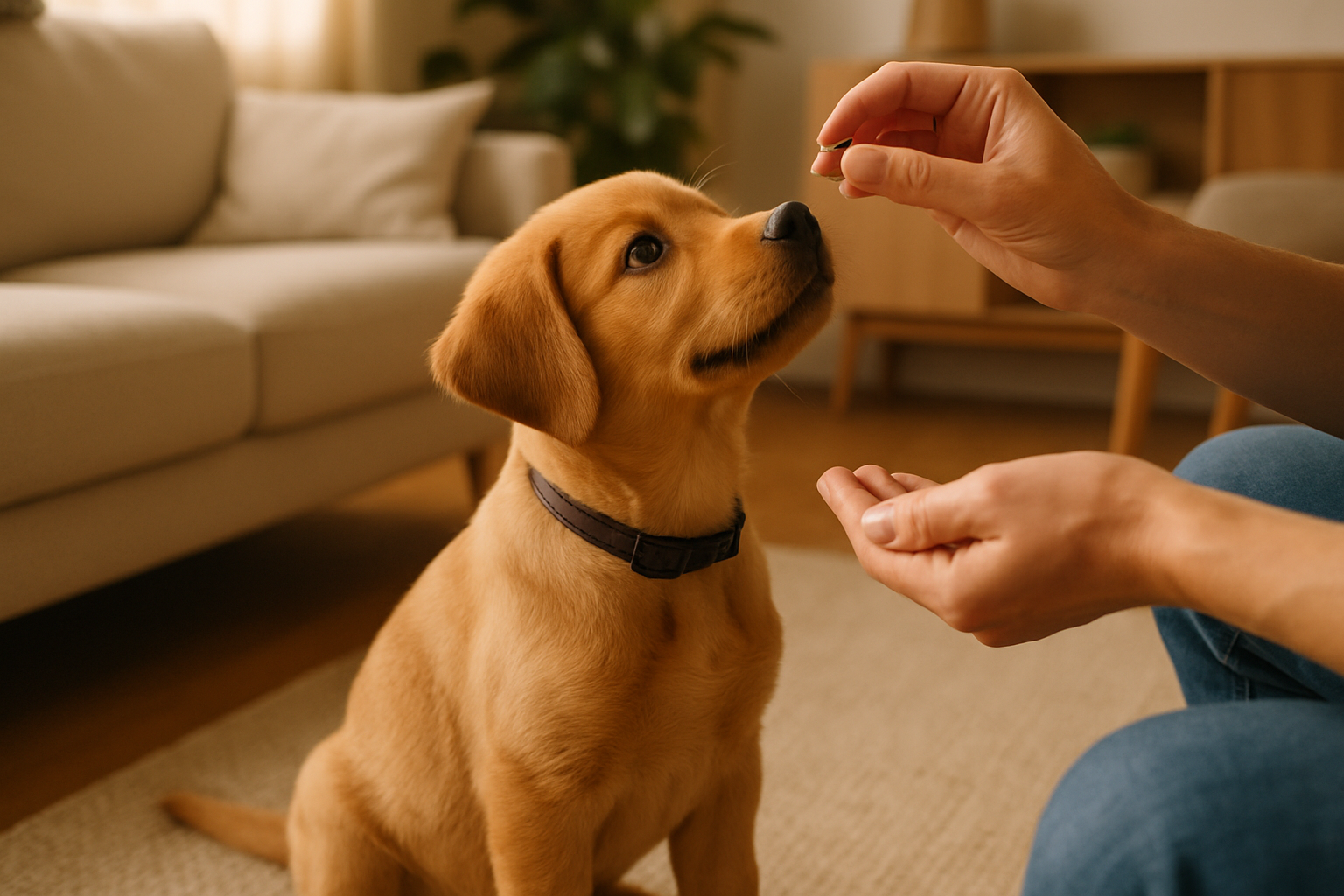
Begin by holding a treat close to your puppy's nose and allow them to sniff and nibble at your hand. This accomplishes two things: it confirms your puppy is interested in the treat, and it establishes focus on you. During this phase, don't give the treat yet—you're simply building anticipation and engagement. [4]
Step 2: Guide the Sit Position
Once your puppy is focused on the treat in your hand, slowly move it upward and slightly backward—approximately 3 inches above their head. The key word here is "slowly." Rapid movements may confuse your puppy or cause them to jump rather than sit. [5]
As your puppy's nose follows the treat upward, their natural body mechanics will cause their rear end to lower toward the ground. This isn't a trick you're teaching them—it's basic physics. When a dog's head goes up, their bottom naturally goes down. If your puppy seems to be jumping instead of sitting, try standing slightly closer so they have to look up more dramatically. [4]
Step 3: Mark and Reward Immediately
The instant your puppy's bottom touches the ground, mark this success with a clicker sound (if using one) or say "Good sit!" in an upbeat, enthusiastic voice. Immediately follow this with the treat and verbal praise like "Yes! Good girl!" or "That's it, good boy!" [5] This timing is critical—your puppy needs to understand that sitting is what earned the reward, not jumping up afterward or any other behavior that follows.
Step 4: Add the Verbal Cue
Once your puppy is consistently sitting when you lure them with the treat, it's time to introduce the verbal cue. Say "Sit" just as you begin moving the treat upward. Repeat this consistently for 10-15 repetitions per session. [5] Your puppy will gradually begin associating the word "sit" with the action and the reward that follows.
Step 5: Fade the Lure
After several successful training sessions where your puppy reliably sits when following the treat, begin removing the food lure. Instead of holding the treat in front of their nose, raise your empty hand above their head in the same motion you used before. Deliver the reward from your other hand once they sit. [4] This teaches your puppy that the hand signal alone is enough to prompt the sit command.
Step 6: Practice Without Treats
As your puppy becomes more proficient, gradually reduce how often you provide food rewards while maintaining enthusiastic verbal praise and physical affection. Start by asking your puppy to sit multiple times before offering a treat, then gradually increase the number of sits required before a reward is given. [2] This weaning process should happen gradually—don't rush it, or your puppy may become confused about whether they should sit anymore.
Training Tips for Maximum Success
Keep Sessions Short and Frequent
Puppies learn best through repetition spread across multiple short sessions rather than one long marathon training session. Aim for 5-10 minute sessions, 2-4 times per day. This prevents your puppy from becoming bored or frustrated while maximizing their learning capacity. [1]
Maintain Consistency Across All Handlers
If multiple people in your household are training your puppy, ensure everyone uses the same verbal cue ("sit"), hand signal, and reward system. Inconsistency confuses puppies and slows their learning progress significantly. [1]
Choose the Right Training Time
Train your puppy when they're alert but not overstimulated. Avoid training sessions right after vigorous play or when your puppy is exhausted. The ideal time is often after a brief potty break and before a meal, when your puppy is motivated by treats but not desperate for a bathroom break.
Use High-Value Rewards
Not all treats are created equal. Identify what truly motivates your individual puppy—whether it's special training treats, tiny pieces of chicken, or enthusiastic praise and play. [5] Some puppies are less food-motivated and respond better to toy rewards or pure enthusiasm from their owner. Tailor your approach to your puppy's unique personality.
Practice in Different Locations
Once your puppy reliably sits in your quiet training space, gradually practice in different rooms of your house and eventually in your yard or other environments. Puppies don't automatically generalize commands—they need to learn that "sit" means the same thing everywhere, regardless of distractions. [2]
Troubleshooting Common Challenges
My Puppy Keeps Jumping Instead of Sitting
If your puppy jumps when you raise the treat, you're likely moving it too high or too quickly. Slow down your hand movement and keep the treat only 2-3 inches above their head. You can also try taking a step closer to your puppy so they're positioned lower relative to your hand, making the sit position more natural. [4]
My Puppy Loses Interest in Training
If your puppy seems unmotivated, evaluate whether you're using truly high-value rewards. Also ensure your training sessions are short enough—even 10 minutes might be too long for some young puppies. Consider training multiple times daily for just 2-3 minutes instead. Additionally, make sure your puppy isn't distracted by hunger, the need for a bathroom break, or environmental stimuli. [5]
My Puppy Sits Inconsistently
Inconsistent performance usually indicates that your puppy hasn't yet fully grasped the connection between the cue and the action. Return to more frequent training sessions with consistent rewards. Ensure you're marking and rewarding the exact moment the sit occurs, not after your puppy has already stood back up. [4]
My Puppy Won't Sit Without a Treat
This is actually a sign that your puppy is still learning the command and isn't ready to fade the lure. Don't rush this process. Continue using treats as a lure for several more weeks before attempting to remove them. Remember, you're teaching your puppy to associate a specific action with a specific cue—this takes time and repetition. [5]
Building on the Foundation
Once your puppy reliably sits on command, you have a powerful foundation for teaching additional commands and behaviors. The sit command naturally leads to other foundational commands like "stay," "down," and "come." [4] Many advanced behaviors and tricks also build upon the sit position, so your investment in mastering this command pays dividends throughout your puppy's training journey.
Consider enrolling in a puppy training class once your puppy has mastered the basics. These classes provide socialization opportunities while reinforcing training principles in a structured environment with professional guidance. [1]
The Bigger Picture: Training and Your Relationship
Teaching your puppy to sit isn't just about obedience—it's about building a strong, trusting relationship with your companion. Training sessions provide quality one-on-one time where you're communicating clearly with your puppy and rewarding their efforts. This positive interaction strengthens your bond and establishes you as a fair, consistent leader in your puppy's eyes. [5]
As you progress through training, remember that patience and consistency are your greatest assets. Every puppy learns at their own pace, and celebrating small victories along the way makes the process enjoyable for both of you. The time you invest now in teaching the sit command will pay dividends in the form of a well-mannered, confident adult dog who understands how to communicate with you and navigate the world safely.
Key Takeaways for Success
- Start training as early as 8 weeks old using short, frequent sessions of 5-10 minutes
- Use high-value treats and enthusiastic praise to motivate your puppy
- Maintain consistency in verbal cues, hand signals, and rewards across all family members
- Mark the exact moment your puppy sits with a clicker or verbal marker like "Good sit!"
- Gradually fade the treat lure once your puppy understands the command
- Practice in various locations to help your puppy generalize the command
- Be patient with the learning process—puppies learn at different rates
- Use the sit command as a foundation for teaching additional commands and behaviors
Sources & References
- https://www.upstatecanine.com/blog/how-to-train-a-puppy/
- https://www.thepuppyacademy.com/blog/2021/3/8/puppy-training-101-teaching-your-puppy-place-command-routines
- https://www.rspca.org.uk/adviceandwelfare/pets/dogs/training/sit
- https://www.halocollar.com/blog/dog-training/the-importance-of-teaching-your-dog-to-sit-and-how-to-do-it/
- https://www.chewy.com/education/dog/training-and-behavior/basic-dog-training-commands-sit