10 Indoor Puppy Games to Burn Energy & Build Bonds
If you're a puppy parent, you've probably experienced that moment: your little furball has seemingly endless energy, the weather is terrible, and you're wondering how on earth you'll tire them out before they redecorate your living room.
Here's the good news: indoor games are one of the most effective solutions for managing puppy energy while simultaneously building obedience, confidence, and your relationship. Unlike simple play, structured games provide both mental and physical stimulation—the combination that actually exhausts puppies and leads to calm, content behavior. [5]
Let's explore 10 fantastic indoor games that will transform your rainy days and keep your puppy entertained, engaged, and well-mannered.
Why Indoor Games Matter for Your Puppy
Before diving into specific games, it's important to understand why they're so valuable. Puppies don't just need exercise—they need enrichment. A puppy that's only physically tired might still be mentally restless, leading to destructive behavior, excessive barking, or unwanted chewing. [5]
Indoor games solve this problem by engaging both their body and mind simultaneously. They also serve as excellent training opportunities, allowing you to reinforce commands, build confidence, and strengthen your bond in a fun, pressure-free environment. [2]
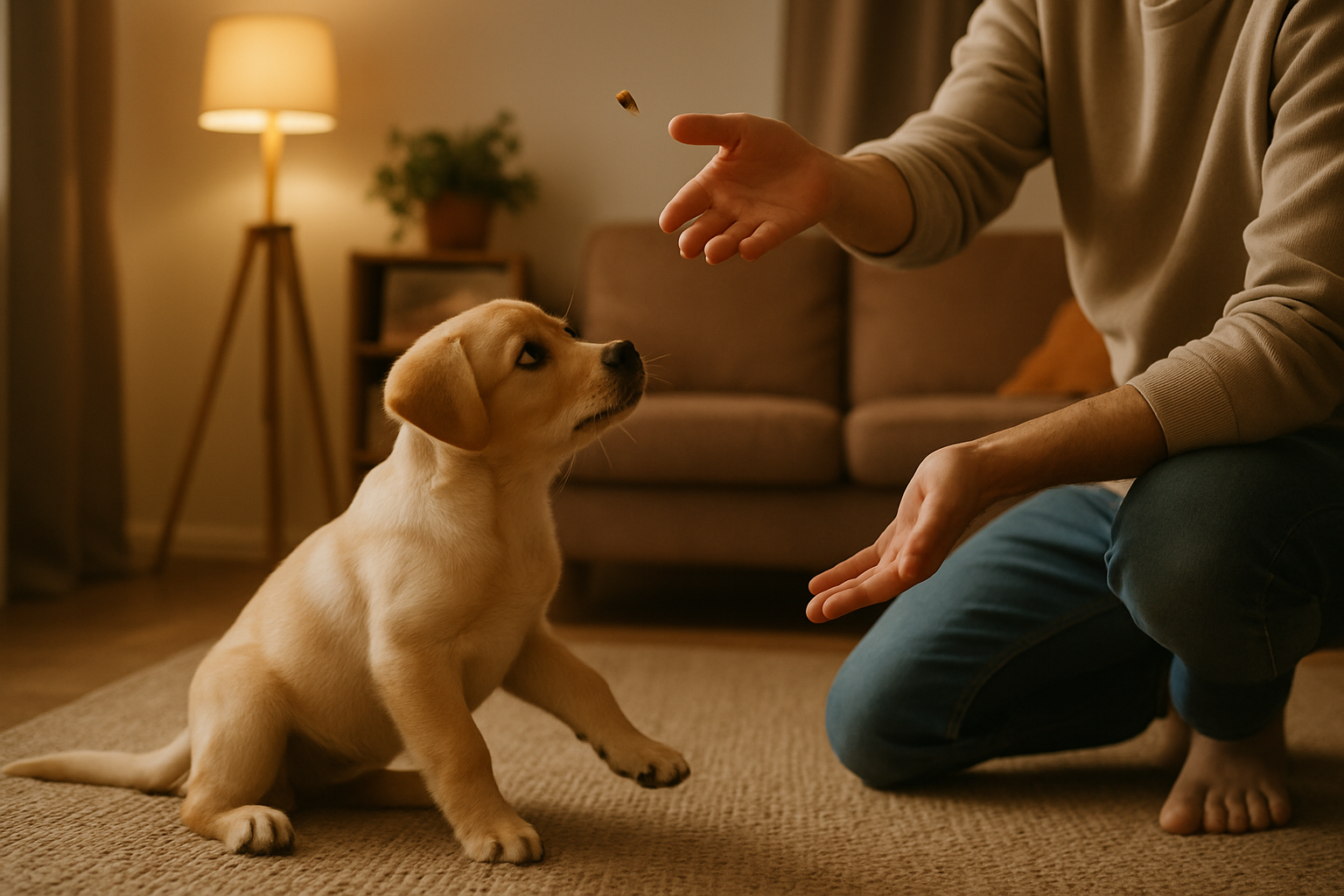
Game 1: The Name Game (Treat Toss)
What it teaches: Name recognition and impulse control
One of the most fundamental skills for any puppy is responding to their name with enthusiasm. The Name Game transforms this essential training into pure fun.
How to play:
- Start in a hallway or confined indoor space with minimal distractions
- Call your puppy's name in an excited, happy tone
- The moment they look at you, toss a treat in an unpredictable direction—over your shoulder, down the hallway, between your legs
- Repeat 5-10 times per session
Pro tips: Vary your treat-toss directions to keep your puppy engaged and prevent them from anticipating the pattern. This game is particularly valuable on days when outdoor exercise isn't possible. [2] Start indoors before attempting this game outside, where distractions might interfere with focus.
Why it works: Your puppy learns that responding to their name results in positive outcomes, creating a strong foundation for recall training later.
Game 2: Chase & Recall
What it teaches: Reliable recall and joyful return
This game taps into your puppy's natural excitement around fast movement and teaches them that coming to you is the best thing ever.
How to play:
- In a safe, clear indoor space (living room or hallway), get your puppy excited
- Run away from them in an exaggerated, playful manner
- Call their name or use your recall cue enthusiastically
- When they catch up, reward with praise, treats, or play
- Repeat 3-5 times, keeping sessions short and fun
Make it challenging: Add a "wait" cue before you run, allowing you to create more distance before calling them. This builds impulse control alongside recall. [2]
Safety note: Ensure your play area is clear of obstacles, furniture corners, and other tripping hazards. You want this to be fun for both of you!
Game 3: Hide & Seek
What it teaches: Searching skills, focus, and problem-solving
Hide and Seek isn't just a childhood favorite—it's an excellent enrichment activity that engages your puppy's natural searching instincts.
How to play:
- Start with your puppy in one room
- Hide in an easy-to-find location (partially behind a door, under a blanket, in a closet doorway)
- Call your puppy's name or use a "find me" cue
- When they locate you, celebrate enthusiastically and reward with treats
- Gradually increase difficulty by hiding in more challenging spots
Progression tips: Begin with obvious hiding spots indoors. Once your puppy masters the game, you can hide treats or toys instead of yourself, which adds another layer of engagement. [2]
Why it works: This game satisfies your puppy's natural desire to search and investigate while building confidence and problem-solving skills.
Game 4: Hand Target
What it teaches: Focus, following cues, and trick foundation
Hand targeting is a simple but powerful game that builds a strong visual connection between you and your puppy while serving as a foundation for more advanced tricks.
How to play:
- Hold your open hand at your puppy's nose level
- Wait for them to touch your hand with their nose (they usually do naturally)
- The moment they make contact, say "yes!" and reward with a treat
- Repeat 10-15 times per session
- Once they understand, add a cue word like "touch" before presenting your hand
Advanced variation: Get your puppy to target your hand through your legs, around corners, or at different heights. The sillier you look, the more engaging it becomes! [2]
Pro tip: Keep sessions short and easy. If your puppy loses interest, you've likely made it too difficult. Puppies need early success to stay motivated.
Game 5: Tennis (The Recall Game)
What it teaches: Responsive recall with multiple people
This game requires a partner but delivers exceptional results for building reliable recall and teaching your puppy to respond to everyone, not just you.
How to play:
- You and a friend stand about 10-15 feet apart in an indoor space
- One person calls the puppy and rewards them with a treat
- The other person then calls the puppy and rewards
- Continue alternating, making recalls unpredictable
- Play for 5-10 minutes per session
Customization: Switch rewards between treats and toys to keep your puppy engaged and prevent them from always expecting the same outcome. [2]
Managing speed: If your puppy is zooming too fast between people, have them sit at the end of each recall to slow things down and build impulse control.
Game 6: Find the Treat (Scent Work)
What it teaches: Nose work, focus, and independent problem-solving
Scent work taps into one of your puppy's most powerful senses and provides significant mental stimulation in a compact space.
How to play:
- Hide a treat under a cushion, blanket, or box in plain sight
- Point to the area and encourage your puppy to "find it"
- Let them use their nose to locate the treat
- Reward their success with praise
- Gradually hide treats in more challenging locations
Progression: Start with obvious hiding spots so your puppy experiences success. Move to under cushions, in tissue boxes, or wrapped in towels as they improve. [2]
Why it's powerful: Nose work is naturally rewarding for dogs and provides intense mental stimulation. A 10-minute scent game can tire a puppy as much as a 30-minute walk.
Game 7: Toy Toss & Retrieve
What it teaches: Fetch, impulse control, and toy engagement
A classic game with a purpose, toy toss builds your puppy's understanding of fetch while providing physical exercise in confined spaces.
How to play:
- Start with a toy your puppy already loves
- Get them excited by playing with the toy
- Toss it a short distance (3-5 feet) down a hallway
- Encourage them to chase and grab it
- Reward their return with treats or praise
- Repeat 5-10 times per session
Building reliability: Always end on a positive note while your puppy still wants to play. This keeps the game exciting and prevents them from getting bored.
Space-saving tip: Hallways are perfect for this game, providing a natural boundary that helps prevent your puppy from running into furniture.
Game 8: The Waiting Game (Impulse Control)
What it teaches: Patience, impulse control, and delayed gratification
This foundational game builds self-control, which translates to better behavior in all other areas of training.
How to play:
- Place a treat on the floor in front of your puppy
- Cover it with your hand or foot
- Wait for your puppy to look away or sit
- The moment they break focus, say "yes!" and let them have the treat
- Gradually extend the waiting period as they improve
Advanced version: Place treats around the room and have your puppy wait for a release cue before eating any of them.
Why it matters: Puppies with strong impulse control are easier to manage, less likely to jump on guests, and better equipped to handle real-world situations.
Game 9: Obstacle Course
What it teaches: Confidence, coordination, and following direction
Transform your living room into a fun obstacle course using household items to build your puppy's confidence and body awareness.
How to set it up:
- Create "jumps" with cushions or low poles
- Make a tunnel from a blanket draped over chairs
- Set up weaving poles using rolled-up towels or PVC pipes
- Create a "balance beam" with a low board or pool noodle
How to play:
- Guide your puppy through the course using treats and encouragement
- Keep obstacles low and easy—you're building confidence, not challenging them
- Celebrate every attempt, successful or not
- Do 2-3 runs per session, keeping it fun and pressure-free
Safety reminder: Ensure all obstacles are stable and appropriately sized for your puppy's age and breed.
Game 10: The Sniff Walk
What it teaches: Calm focus and mental engagement
While not as energetic as other games, the sniff walk provides significant mental stimulation and is perfect for winding down after more active play.
How to play:
- Hide treats throughout a room or designated area
- Let your puppy explore at their own pace, sniffing everything
- Allow them to find treats independently without guidance
- Play for 10-15 minutes
Why it's valuable: Sniff walks satisfy your puppy's natural investigative instincts, provide mental stimulation, and naturally calm excited puppies—making it perfect before bedtime or quiet time.
Essential Tips for Indoor Puppy Games
Start simple: Begin every game at an easy level. Your puppy needs early success to stay motivated and engaged.
Keep sessions short: 5-15 minutes is ideal for puppies. Multiple short sessions throughout the day are more effective than one long session.
Make it fun: Your enthusiasm is contagious. Puppies respond to your energy and excitement, so bring genuine joy to playtime.
Rotate games: Some puppies are so intelligent that they'll outsmart you if you play the same game repeatedly. [2] Variety keeps them engaged and prevents boredom.
Use high-value rewards: Reserve your puppy's favorite treats for games to make them extra motivating.
Minimize distractions initially: Practice new games indoors before moving to busier environments. This helps your puppy focus and learn faster.
End on a positive note: Always finish games while your puppy still wants to play. This keeps them eager for the next session.
Tailoring Games to Your Puppy's Age & Energy Level
Young puppies (8-12 weeks): Focus on Name Game, Hand Target, and Hide & Seek. Keep all games extremely short and reward generously.
Growing puppies (3-6 months): Introduce Chase & Recall, Tennis, and Toy Toss. Gradually increase difficulty and session length.
Older puppies (6-12 months): Add Obstacle Course, Scent Work variations, and more complex Hide & Seek. These puppies can handle longer, more challenging games.
High-energy breeds: Prioritize games combining physical and mental exercise, like Obstacle Course and Tennis. Play multiple games daily.
Lower-energy breeds: Emphasize mental games like Scent Work and Hand Target. Keep physical games shorter and less intense.
The Bigger Picture: Building Your Bond
Beyond burning energy and teaching commands, these indoor games serve a deeper purpose: they strengthen the relationship between you and your puppy. When you play together, you're not just training—you're building trust, communication, and mutual respect. [5]
Puppies that play structured games with their owners show improved obedience, fewer behavioral problems, and stronger emotional bonds. They learn that you're fun, predictable, and worth paying attention to—which translates to better behavior in every situation.
Creating Your Indoor Game Routine
Rather than randomly playing games, consider creating a structured routine:
- Morning: Name Game + Chase & Recall (high energy)
- Midday: Hand Target + Hide & Seek (moderate energy)
- Evening: Scent Work + Sniff Walk (wind-down)
This approach ensures your puppy gets consistent mental and physical stimulation while preventing boredom and behavioral issues.
Final Thoughts
Rainy days, apartment living, and busy schedules no longer need to mean a bored, destructive puppy. These 10 indoor games prove that you don't need a backyard or perfect weather to raise a happy, well-behaved pup. [5]
Start with one or two games your puppy enjoys, master them, then gradually add others. Remember that the goal isn't perfection—it's creating moments of joy, learning, and connection with your furry friend.
Your puppy is ready to play. Are you?